
We earn a commission if you buy through these links. Learn more
Anathem
Anathem is a demanding, idea-rich science fiction novel whose world of cloistered mathematicians and philosophers rewards patient readers with one of the genre's most original settings.
What It's About
Anathem is a long science fiction novel set on Arbre, a planet whose intellectual life has been organized around walled communities of scholars called mathic monasteries. Their members, the avout, have renounced ordinary worldly life to study mathematics, philosophy, and science, and they live by strict rules about what they may see, learn, and say. The story follows a young avout named Erasmas as his small, orderly world is disturbed by events from beyond its walls. Stephenson builds the setting from the inside out, and much of the book's pleasure comes from watching that world take shape.
The approach is expansive, talky, and unhurried, closer to a philosophical novel with a science fiction frame than to a brisk adventure. Long stretches are given over to argument about how knowledge works, what counts as real, and what a community owes to the people outside it. Stephenson also invents a whole vocabulary for monastic life, and the early chapters ask you to absorb it through context rather than explanation. Action arrives in bursts, but the book trusts its reader to enjoy ideas for their own sake. Reading it feels like being admitted into a closed community slowly and with some confusion, then finding its internal logic increasingly satisfying.
The experience is rewarding but demanding. Expect a good stretch of groundwork before the pace feels reliable, and be prepared to reread passages when the terminology piles up. Readers who want a clear plot early on, or who prefer their science fiction fast and lean, may find the first part a test of patience.
Read this if you…
- enjoy big, slow-building science fiction where the setting is a main attraction
- like philosophical debate worked into a story with real stakes
- don't mind learning an invented vocabulary and a long runway before the plot tightens
Skip it if you…
- want a fast, tightly plotted book you can finish in a few evenings
- prefer fiction driven mainly by character intimacy rather than by ideas
Key Ideas
- 1
Knowledge as a disciplined way of life
The avout treat thinking as a vocation with its own rules, rituals, and hierarchies. The book asks what separates a genuine community of inquiry from a closed system that protects its own assumptions, and it lets the reader see both the discipline's strengths and its blind spots without settling the question too neatly.
- 2
Walls as both protection and prison
The monastery's separation from the wider world is presented as a source of focus and safety, but also as a limit on what its members can perceive. Stephenson keeps returning to the tension between withdrawing to think and engaging with the messy society that depends on that thinking, and the question has real stakes in the story.
- 3
Invented language as worldbuilding
Stephenson coins a large set of terms for the monastic world, its institutions, and its ideas. The vocabulary can feel like homework at first, but it gives the setting a density and internal consistency that few science fiction books achieve, and it makes the world feel lived in rather than sketched.
- 4
Philosophy of mathematics dramatized
Debates about whether abstract ideas exist independently of minds, and what mathematics actually tells us about reality, run throughout the novel. Stephenson stages these arguments as conflicts between characters with different loyalties, so the ideas carry emotional weight rather than sitting in lectures.
Limitations
The book is very long, and its pacing is uneven. Some readers find the early chapters slow and the invented terminology tiring, and the extended philosophical discussions can feel like digressions when you are waiting for the story to move. Characters are sometimes more vehicles for arguments than fully drawn people. The novel also rewards a patient, rereading mindset, so readers used to fast genre fiction may feel it asks more than it gives in the first third.
Questions Readers Ask
- Do I need a background in mathematics or philosophy to enjoy Anathem?
- No specialist knowledge is required. The mathematical and philosophical ideas are introduced in context and explained through the characters' debates. Curiosity about how ideas work matters more than training. Readers who enjoy thinking through arguments will find the book rewarding, even when some passages go over their heads.
- How does Anathem compare to Stephenson's Snow Crash or Cryptonomicon?
- Anathem is slower and more contemplative than Snow Crash, which is fast, satirical, and punchy. It is closer in spirit to the intellectual density of Cryptonomicon but set in an invented world rather than our history. If you liked Stephenson's ideas but found his pacing exhausting, Anathem may feel like a more patient, deliberate book.
- Published
- 2008
- ISBN
- 9780061474101
- Difficulty
- advanced
- Category
- Science Fiction
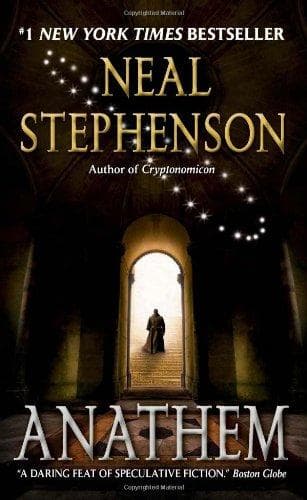
Book details and cover from Google Books.
Ready to read Anathem?
Get your copy on Amazon, or listen to it on Audible. We earn a commission if you buy through these links.