
We earn a commission if you buy through these links. Learn more
An Incomplete Education
by Judy Jones
Guide by the Books of the Day editors · Updated · How we write our guides
A witty, browsable catalogue of facts for adults who suspect their schooling had gaps, best read in short sessions rather than straight through.
What It's About
An Incomplete Education is a general-knowledge reference book, not a novel, so the Fiction category listed on this page is incorrect. Judy Jones and William Wilson gather a large number of facts that they argue educated adults are expected to know but often do not. The material is arranged in short entries grouped by subject, spanning literature, history, science, the arts, and everyday culture, so the book reads more like a well-organized reference than a continuous argument.
The style is brisk and playful. Entries are compact, often a name, term, or question followed by a few lines of explanation, which makes it easy to dip in and out. The tone sits closer to a quiz-night companion than a textbook. Much of the charm comes from the choice of items and the phrasing, not from long analysis or sustained storytelling.
The experience is best described as browsing. You will pick up scattered facts quickly, and some will stick, especially the ones that connect to things you already half-know. There is little narrative pull, so it works well in short sessions, on a commute, or alongside another book rather than as a single cover-to-cover read.
Read this if you…
- want a quick, low-pressure refresher on a wide range of general knowledge
- enjoy trivia-style reading you can pick up and put down
- are curious about what a generation of educated readers was once expected to know
Skip it if you…
- want sustained argument, analysis, or a single subject explored in depth
- need current, up-to-date facts for work or research
Key Ideas
- 1
A shared baseline of general knowledge
The book's core premise is that a common stock of cultural, historical, and scientific reference points makes conversation and reading richer. It treats these facts as a kind of background equipment that many people feel they missed, and it frames learning them as a practical, rather than purely academic, pursuit.
- 2
Short entries as memory hooks
Rather than building long arguments, the book relies on self-contained entries that are easy to remember and repeat. Each item gives you a small anchor, such as a name, date, or idea, that can connect to other knowledge later. This makes the book more useful as a prompt for further reading than as a source of deep understanding.
- 3
Breadth over depth by design
Coverage is wide and shallow on purpose. A reader who wants a thorough treatment of any single subject will be disappointed, but a reader who wants to sample many fields quickly will find the format efficient. The trade-off is that context and explanation are kept to a minimum.
- 4
Wit in the selection and phrasing
The authors' main tool is not argument but choice: which facts to include and how to put them. The humor comes from juxtaposition and tone, which keeps a catalogue of facts from feeling like homework. This is the feature most readers remember, and it is also what makes the book feel dated or uneven to some.
Limitations
Because the book was first published in the late 1980s, many facts, references, and assumptions are dated, and some entries may no longer be accurate. Its reference points lean toward English-language and largely Western culture, so readers from other traditions may find gaps. The format also limits explanation: an entry tells you that something matters, but rarely why. Readers looking for context or critical perspective will need to go elsewhere.
Questions Readers Ask
- Is An Incomplete Education a novel?
- No. It is a nonfiction reference book of general-knowledge entries, arranged by subject and written in a witty, quiz-like style. The Fiction category on this page does not match the book, so treat the description here as the accurate guide to what you will get.
- Is it still worth reading today?
- As a browsing book, yes, though not as a source of current facts. Many entries are dated, so it works best as a window into what educated readers were expected to know in the 1980s and as a prompt to check facts you encounter in it.
- How does it compare to Cultural Literacy?
- E.D. Hirsch's Cultural Literacy makes a sustained argument for a shared knowledge base and explains its reasoning at length. An Incomplete Education skips the argument and offers short, playful entries instead. Choose Hirsch if you want the case; choose Jones and Wilson if you want to sample facts quickly.
- Published
- 1988
- ISBN
- 9780679447795
- Difficulty
- beginner
- Category
- Fiction
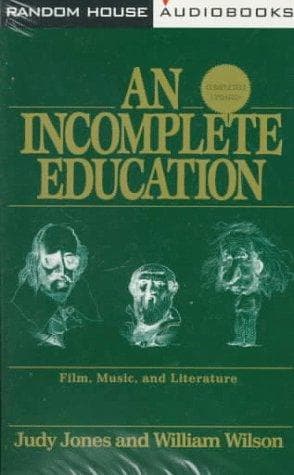
Book details and cover from Google Books.
Ready to read An Incomplete Education?
Get your copy on Amazon, or listen to it on Audible. We earn a commission if you buy through these links.