
We earn a commission if you buy through these links. Learn more
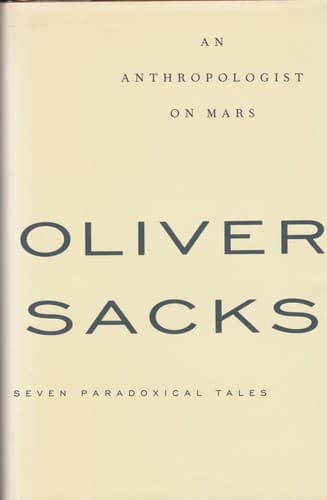
An Anthropologist on Mars
by Oliver Sacks
Guide by the Books of the Day editors · Updated · How we write our guides
Seven portraits from a neurologist's clinic show how unusual brains build unusual worlds, told with warmth and curiosity that make a difficult subject feel human and readable.
What Creators Say About An Anthropologist on Mars
2 creators reviewed An Anthropologist on Mars on YouTube between 2014 and 2021, with 3K views between them. Their opinions are their own; we picked these reviews, we didn't write them.
What It's About
An Anthropologist on Mars, published in 1995, collects seven case studies from Oliver Sacks's clinical work. Each chapter follows a person whose brain works differently, whether through a loss of color, a restored but bewildering sense of sight, autism, or another condition that reshapes perception and identity. Sacks treats his subjects less as diagnoses and more as people who have built full lives around their differences, and the book's title points to that stance: he approaches them like an observer arriving from elsewhere, curious about how their worlds are put together.
The approach is narrative. Sacks mixes careful observation, medical context, and long stretches of the subjects' own accounts, so the book reads more like linked short stories than a textbook. The science is present but kept light, and the emphasis falls on what it feels like to see, think, and move through the world in these altered ways.
Reading it is a gentle, reflective experience. The chapters are self-contained, so you can take them in any order, and many readers find themselves rethinking what they assume about normal perception. The tone is warm and occasionally wondering, though Sacks's own voice is always present and shapes how each story is framed.
Read this if you…
- want humane, story-driven accounts of how the brain shapes experience
- are curious about sight, color, or perception and how they can fail or return
- want to understand autism or neurological conditions from the inside
Skip it if you…
- want rigorous, up-to-date science, data, or detailed clinical method
- prefer a book that argues a single thesis rather than a set of portraits
Key Ideas
- 1
Difference as a different way of being
Sacks repeatedly argues that conditions such as autism or lifelong blindness are not only lists of missing abilities. Each subject has developed distinct strengths, habits, and ways of making sense of experience. The book asks readers to consider what a life looks like from inside a mind that is built differently, rather than measuring it against a standard.
- 2
Perception is constructed, not simply received
Several cases show that seeing is a learned, brain-dependent process. When one subject regains sight after decades of blindness, the world does not arrive as a clear picture; it has to be assembled through practice. These stories make it hard to think of the senses as a window onto a fixed reality.
- 3
Biography over clinical labels
Sacks writes case histories in the form of life stories. He gives his subjects names, histories, humor, and frustrations, which turns each diagnosis into a person with preferences and a point of view. The narrative choice is one of the book's most distinctive features and a large part of its appeal.
- 4
Adaptation and the shape of an identity
Many of the subjects find workarounds, compensations, or passions that define them. The book pays attention to how people build selves around conditions that others might see only as impairments. It is less interested in cures than in the strategies people invent and the meanings they assign to their own minds.
Limitations
The science is dated, reflecting research and medical understanding from the early 1990s, so readers looking for current findings will need to look elsewhere. The selection of cases is small and personal, which means it cannot represent the range of these conditions. Some of the language and framing around disability feels old-fashioned by today's standards. Because the stories pass through Sacks's perspective and writing, the subjects' own voices are often mediated, which some readers find limiting.
Questions Readers Ask
- Do I need a background in neuroscience to read it?
- No. The book is written for general readers. Sacks explains the relevant medical ideas in plain language and spends more time on human experience than on technical detail. A basic curiosity about how the mind works is enough to follow every chapter.
- How does it compare to The Man Who Mistook His Wife for a Hat?
- Both are case-study collections by Sacks, and both are readable. The Man Who Mistook His Wife for a Hat is the more famous book and covers a wider range of neurological conditions. An Anthropologist on Mars is more focused on individuals who perceive or experience the world in unusual ways, and it gives more space to questions of identity.
- Is it still worth reading decades later?
- Yes, mainly for the stories. The scientific framing has aged and some terminology is outdated, but the portraits of people adapting to unusual minds remain moving and thought-provoking. Read it as a window into how these lives were understood and described, not as a current medical guide.
- Published
- 1995
- ISBN
- 9781035068357
- Difficulty
- beginner
- Category
- Psychology
Book details and cover from Google Books.
Ready to read An Anthropologist on Mars?
Get your copy on Amazon, or listen to it on Audible. We earn a commission if you buy through these links.