
We earn a commission if you buy through these links. Learn more
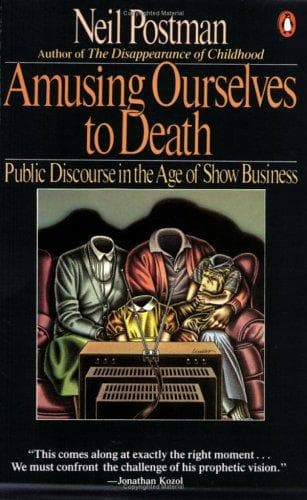
Amusing Ourselves to Death
A short, sharp 1985 argument that the medium of a culture shapes its public life, showing how television turned news, politics, and education into entertainment and why that matters now.
What It's About
Amusing Ourselves to Death is a work of media criticism rather than fiction, so the Fiction category listed for it here does not match the book. Published in 1985, it argues that the form through which a society handles information shapes what that society can think about and how it talks. Neil Postman's main target is television, and his claim is that its dominant style turned public life into a kind of show.
The book's method is to set two warnings side by side. He takes Orwell's 1984, where people are controlled through fear and censorship, and Huxley's Brave New World, where people are controlled through pleasure and distraction, and argues that the Huxley picture better describes modern life. He also looks back at how print once supported serious public argument, then traces how the telegraph and later television separated information from context and presented it as entertainment.
Reading it feels like listening to a sustained, witty lecture from a critic who is worried about what he sees. The prose is clear, the chapters are short, and the argument builds through repeated examples more than dense theory. You finish with a sharper eye for how news, political campaigns, and schooling are packaged, rather than a set of facts to memorize.
Read this if you…
- want a concise, argumentative book on how media technologies shape public life
- are interested in media studies, communication theory, or the history of television
- enjoy sharp, opinionated cultural criticism that rewards rereading
Skip it if you…
- want a neutral survey of modern media research or current data on screens and attention
- are looking for a book that deals mainly with the internet, social media, or streaming
Key Ideas
- 1
The medium shapes what we can think
Postman treats communication technologies as more than neutral containers for ideas. Each form, from speech to print to the screen, makes certain kinds of argument easy and others nearly impossible. His core question is less about what television shows than about what kind of public conversation its form encourages.
- 2
Orwell feared censors, Huxley feared amusement
The book's central contrast asks which dystopia we are closer to. Orwell imagined a society ruled by banned books and fear. Postman argues that a culture overwhelmed by pleasant, trivial material may lose the habit of serious thought without anyone forbidding anything, which is the more uncomfortable point he wants readers to take away.
- 3
Television turns serious matters into entertainment
Postman argues that television's demand to hold attention pushes news, religion, and politics toward brevity, emotion, and image. Information arrives in fragments with little context, and the viewer is rewarded for being entertained rather than for understanding. This is the book's most cited and most debated claim.
- 4
Print once set the terms of serious debate
Postman looks back at a time when written argument was the norm in public life, using historical examples of political debate to show what sustained reasoning looked like. The contrast gives his criticism of later media a concrete baseline, though readers should note that the historical picture is selectively drawn.
Limitations
The book was written before the internet and social media, so its examples are almost entirely about broadcast television and the news of its era. Critics argue that Postman idealizes print and the past, and that his sweeping claims about audiences underrate viewers' independence. Its evidence is mostly anecdotal and focused on the United States, and some of its predictions and comparisons are more rhetorical than rigorously tested.
Questions Readers Ask
- Is Amusing Ourselves to Death a novel?
- No. Despite the category listed for it here, it is nonfiction. Neil Postman wrote it as a work of cultural and media criticism, using examples from television, politics, and history to make an argument about how public discourse changes with the medium that carries it. Readers looking for story or characters will not find them.
- Is the book still relevant with social media and streaming?
- Its specific examples are dated, since it predates the internet and today's platforms. Its central question, about how a medium's form shapes what gets taken seriously, still applies well to feeds and short videos. Many readers use it as a framework for thinking about newer media rather than as a guide to them.
- Should I read it instead of Orwell or Huxley?
- You do not need to choose. Postman's book is a commentary on the two novels rather than a substitute for them. If you have not read Brave New World, reading it first will make Postman's argument much clearer, and 1984 gives useful context for his comparison.
- Published
- 1985
- ISBN
- 9780143036531
- Difficulty
- intermediate
- Category
- Fiction
Book details and cover from Google Books.
Ready to read Amusing Ourselves to Death?
Get your copy on Amazon, or listen to it on Audible. We earn a commission if you buy through these links.