
We earn a commission if you buy through these links. Learn more
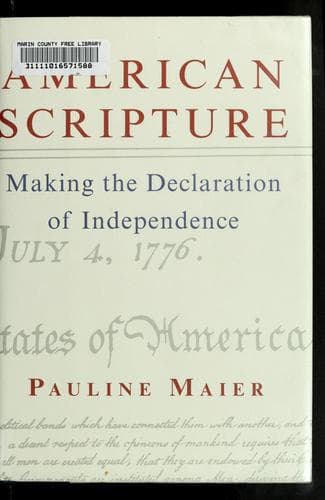
American scripture
Guide by the Books of the Day editors · Updated · How we write our guides
Pauline Maier shows how a practical 1776 document became America's sacred founding text, making this a sharp, well-sourced read for anyone curious about how political writing gains authority over time.
What Creators Say About American scripture
2 creators reviewed American scripture on YouTube between 2025 and 2026, with 254 views between them. Their opinions are their own; we picked these reviews, we didn't write them.
What It's About
American Scripture, by the historian Pauline Maier, follows the Declaration of Independence from its drafting in 1776 to its status as a near-sacred national text. Its central puzzle is why a document that was mostly a justification for breaking with Britain, and that drew little notice when first issued, came to be treated as the country's founding creed. Maier does not treat the Declaration as a timeless philosophical statement. She treats it as a political act with a history.
The approach is that of a careful historian. She works through the drafting, the edits Congress made, the early printings and reactions, and then the long afterlife of the text in speeches, debates and public memory. The writing is clear and measured, with little jargon, and she is patient with the messy details. Reading it feels like watching a reputation being built one generation at a time, with the text taking on new meanings as the country changed.
The experience is more intellectual than emotional. You will not get a rousing patriotic narrative, and you will not get a sustained argument about natural rights in the abstract. Instead, the book asks you to reconsider what you thought you knew about the document and the people who invoked it. It rewards readers who already know the basic outline of American history and want to see how a text acquires authority.
Read this if you…
- want to understand how a founding document became a national symbol
- are interested in how historians read political texts in their original context
- already know the basic story of 1776 and want something deeper
Skip it if you…
- want a narrative of the Revolutionary War or its battles
- are looking for a philosophical treatment of natural rights or a legal reading of the text
Key Ideas
- 1
A practical document before a sacred one
In 1776 the Declaration was a working piece of political persuasion, meant to explain to the world and to colonists why separation was justified. Congress revised Jefferson's draft, and the document was not yet treated as the nation's creed. Maier asks readers to see it first as a product of its moment before judging its later reputation.
- 2
Reputation built through repeated use
After the Revolution the Declaration faded from view in many ways, and its standing grew as politicians, reformers and writers invoked it in arguments about slavery, citizenship and rights. Each use gave it new meaning. The book shows how a text becomes authoritative through repetition rather than possessing that authority from the start.
- 3
The slavery debate and the meaning of equality
The conflict over slavery pushed the phrase about human equality to the center of public argument. Abraham Lincoln's use of the Declaration helped establish it as a standard against which the nation was measured. Maier traces how that reading was contested by others who saw the document differently.
- 4
Why the Declaration's authority stays contested
Reverence for the text has never been unanimous. People across the political spectrum have claimed it, and disagreements over its meaning are part of its story. This helps explain why debates about the founding still reach back to this one document.
Limitations
The book is narrow by design. It concentrates on one document, so readers wanting the broader war, the making of the Constitution, or the lives of the people involved will need other sources. Some critics note that the story leans heavily on elite writers, leaders and public speeches, leaving ordinary voices thinner. The prose is measured rather than lively, and some chapters move slowly through reception history. Its 1997 publication date means later scholarship on the Declaration's legacy is not included.
Questions Readers Ask
- Who is American Scripture best suited to?
- It suits readers who already have a working knowledge of American history and want to understand how the Declaration of Independence came to carry so much weight. Students, teachers and curious general readers tend to get the most out of it. If you are new to the period, a broader survey of the Revolution first will make the book's arguments easier to follow.
- How does it compare with a general history of the Revolution?
- A general history covers the war, the politics and the people in a wide sweep. Maier's book is much narrower. It stays with one document and its reception, so it is best read as a companion to a broader account rather than a replacement for one.
- Is the book still relevant to current debates about the founding?
- Yes, because the arguments over how to read the Declaration have continued well past its publication. Maier's account of how the text was claimed by different groups helps explain why modern disputes about the founding often invoke it. Readers should keep in mind that the book does not cover later scholarship.
- Published
- 1997
- ISBN
- 9780712665209
- Difficulty
- intermediate
- Category
- History
Book details and cover from Google Books.
Ready to read American scripture?
Get your copy on Amazon, or listen to it on Audible. We earn a commission if you buy through these links.