
We earn a commission if you buy through these links. Learn more
Altered traits
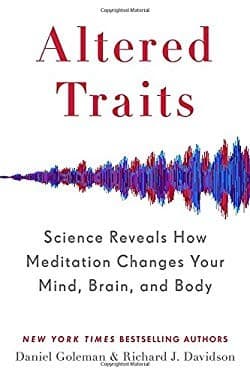
Goleman and Richard Davidson ask whether meditation leaves lasting changes in the mind, or only a calmer feeling during practice, and they answer with a readable tour of the research.
What It's About
Altered Traits, written by Daniel Goleman with neuroscientist Richard Davidson, asks a plain question: does meditation change the person, or only how they feel while sitting? The authors separate temporary state effects, the calm that fades after a session, from lasting trait changes that show up in everyday life. Much of the book is an argument that the second kind is real and can be studied.
The method is part science review, part reporting. Goleman brings his journalist's habit of interviewing practitioners and summarizing studies, while Davidson's laboratory work on the brain sets the scientific frame. The book spends considerable time on long-term practitioners, including Tibetan Buddhist monks and experienced meditators in Western study groups, and on the dialogues that brought scientists and contemplative teachers together. The prose is accessible, and each study is explained in terms of what it measured.
Reading it feels like sitting in on a long conversation between a science writer and a researcher who is careful about what the evidence does and does not show. It is more hopeful than skeptical, but it also takes time to discuss where practices can go wrong.
Read this if you…
- have tried meditation and want to know whether it does anything lasting
- want a research-based view of contemplative practice without much hype
- are curious about compassion training and how it is studied in the brain
Skip it if you…
- want a step-by-step guide to starting a practice
- are looking for a rigorous, skeptical meta-analysis of the field
Key Ideas
- 1
State effects versus lasting trait change
The central distinction is between the temporary calm of a single session and durable shifts in attention, emotion, and behavior. The authors argue that only the second kind matters for a life, and much of the book is an attempt to show which practices produce it and how researchers try to tell the difference.
- 2
Different practices train different capacities
Focused attention, open awareness, and compassion or loving-kindness practices are presented as distinct skills that build different abilities. The book suggests that choosing a practice is less about general wellness and more about what you want to develop, and it explains how each is studied in the lab.
- 3
Long-term practitioners as a natural experiment
People who have meditated for thousands of hours offer a window into what sustained practice might do. The book treats these cases as valuable evidence while acknowledging the problems of small samples and self-selection, since people who keep up a demanding practice may differ from the start.
- 4
Meditation is not uniformly benign
The authors take seriously the reports that some practitioners have difficult or destabilizing experiences. They argue that intensity, duration, and the presence of qualified guidance all matter, which makes the book more cautious than the wellness-marketing image of meditation.
Limitations
The book leans on the authors' interpretation of a body of research that is still developing, and many of the studies it describes are small. Some long-term practitioner comparisons rely on volunteers who chose to take part, which makes cause and effect hard to pin down. Critics also note that the book is at times more inspirational than critical, and that its coverage is weighted toward Buddhist-derived practices and the authors' own research circles. Since its 2017 publication, the field has moved on, so newer work may refine or complicate its claims.
Questions Readers Ask
- Is Altered Traits a practical guide to meditation?
- Not really. It explains what research says meditation may do and why the distinction between momentary and lasting change matters. It includes some discussion of practices, but it is not a how-to manual. Readers who want instructions should pair it with a dedicated beginner's guide or a teacher.
- How does it compare to Goleman's Emotional Intelligence?
- Emotional Intelligence is a broader popular book about emotional skills in work and life. Altered Traits is narrower and more technical, focusing specifically on meditation research and the brain. If you liked the author's clear summaries of psychology, you will likely find this one more demanding but more focused.
- Published
- 2017
- ISBN
- 9780399184383
- Difficulty
- intermediate
- Category
- Science
Book details and cover from Google Books.
Ready to read Altered traits?
Get your copy on Amazon, or listen to it on Audible. We earn a commission if you buy through these links.