
We earn a commission if you buy through these links. Learn more
All the Light We Cannot See
Guide by the Books of the Day editors · Updated · How we write our guides
A patient, sweeping WWII novel whose two young narrators, a blind French girl and a German orphan, are pulled toward each other by a radio signal and a legendary gem.
What Creators Say About All the Light We Cannot See
2 creators reviewed All the Light We Cannot See on YouTube between 2014 and 2018, with 324K views between them. Their opinions are their own; we picked these reviews, we didn't write them.
What It's About
The novel alternates between two young people during the Second World War. Marie-Laure LeBlanc, blind since childhood, lives in Paris with her father, a locksmith who works at the Museum of Natural History, and she learns the city through touch, sound, and smell. Werner Pfennig, an orphan from a German mining town, has a gift for taking apart and repairing radios, which earns him a place at an elite Nazi school. Their stories run in parallel from the mid-1930s into the 1940s, with the siege of Saint-Malo as a fixed point that both timelines keep returning to.
The style is lyrical and built from short sections, many only a few pages long, so the book moves quickly even as it lingers on sensory detail. Doerr pays close attention to small objects, natural history, and the mechanics of wiring and radios, and the prose is more ornate than spare. A large diamond called the Sea of Flames runs through the story as an object many characters chase, but it works more as a thread than as a thriller engine.
Reading it feels like being carried through a long, emotionally heavy story with moments of real tenderness. It asks you to hold two very different views of the same catastrophe, and the slow accumulation of detail rewards patience. Expect a book more concerned with attention and fragility than with plot mechanics.
Read this if you…
- want a patient, character-driven WWII novel rather than a battle story
- enjoy lyrical prose and close attention to sensory detail
- are willing to follow two timelines and a slow build toward their connection
Skip it if you…
- want fast plot momentum or a tight, twisty thriller
- find ornate, sentimental prose hard to enjoy across several hundred pages
Key Ideas
- 1
Seeing the world without sight
Marie-Laure's blindness shapes the book's attention to touch, sound, smell, and texture. A city becomes a map built from sensation rather than sight, and the reader is asked to experience the world in that more physical way. This gives the prose much of its distinctive texture and makes ordinary moments feel charged with meaning.
- 2
Technology as both gift and trap
Werner's talent with radios offers him a way out of poverty and a sense of purpose. The same skill, however, binds him to a regime and its war effort. The novel examines how a clever, sincere young person can be absorbed into a system whose aims he has not fully examined.
- 3
Parallel lives under one catastrophe
Two narrators on opposite sides of the war show how ordinary people were shaped differently by the same events. Doerr keeps the timelines separate for long stretches, so the reader feels the gap between their experiences before the story begins to draw them together.
- 4
Quiet acts of courage and conscience
The book is less about battles than about small choices: to listen, to help a stranger, or to refuse an order. These decisions carry more weight than the spectacle of war, and the novel suggests that moral life under occupation was often lived in private, unnoticed moments.
Limitations
Critics have pointed to coincidence and a tendency toward sentimentality, and some find the prose too decorative for its subject. The Sea of Flames plot leans on contrivance, and the German perspective is filtered largely through one boy's education, which may leave the wider machinery of the regime underdrawn. The novel is more interested in individual moral moments than in the political or military history of the occupation, so readers wanting detailed context will need other sources.
Questions Readers Ask
- Is it a good choice if I have already read The Book Thief?
- Both novels use young narrators, lyrical prose, and a World War II setting, so fans of one often enjoy the other. Doerr's book is more structured around two linked timelines and a physical quest, while Zusak narrates through a distinctive voice. If you valued the intimacy of Zusak's storytelling, expect Doerr's pacing to be slower but more concentrated.
- Does the book require background knowledge of World War II?
- No. Doerr introduces the setting through the characters' daily lives rather than through summary, so readers with little history can follow the story. Some sense of the occupation of France and the rise of the Nazi state adds weight to the stakes, but it is not required to enjoy the book.
- Published
- 2014
- ISBN
- 9780008138301
- Difficulty
- beginner
- Category
- Fiction
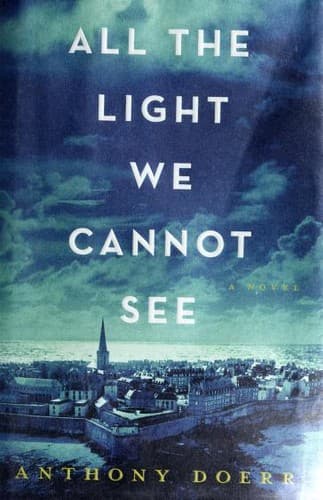
Book details and cover from Google Books.
Ready to read All the Light We Cannot See?
Get your copy on Amazon, or listen to it on Audible. We earn a commission if you buy through these links.