
We earn a commission if you buy through these links. Learn more
All Quiet on the Western Front
On screen: All Quiet on the Western Front (film, 1930) · All Quiet on the Western Front (film, 2022)
A young German soldier's blunt account of trench warfare in the First World War, still the most affecting case for why the war itself was the problem.
What It's About
All Quiet on the Western Front, published in 1929, follows Paul Bäumer, a young man who enlists with a group of schoolmates after their teacher's rhetoric about glory stirs them up. Remarque, who served on the German side and was wounded, builds the novel from a soldier's close view: mud, rations, shelling, and the small routines that keep men alive. The narration is first person and unembellished, and the prose is short, declarative, and often repetitive in a way that mirrors how days blur at the front.
What makes the reading distinctive is the gap it keeps opening between what Paul is told and what he sees. The book moves between the front and a home leave, and the scenes away from combat are where its anger becomes sharpest. It is not a tactical history; battles appear as noise and confusion rather than as maps. Expect a book that is quick to read and hard to forget, with long stretches of ordinary talk among soldiers that carry as much weight as the violence.
Reading it is less like following a plot than sitting with a witness who is tired, sometimes bitter, and often tender about the men around him. The experience is cumulative: small details pile up, and by the middle of the book the losses feel personal, which is precisely the effect Remarque was after.
Read this if you…
- want a clear, unsentimental picture of First World War infantry life from the inside
- are interested in how anti-war literature turns personal experience into argument
- like short, direct prose that builds emotional weight through accumulation
Skip it if you…
- want a strategic or military history with maps, commanders, and battle timelines
- need a plot with strong suspense and a clear sequence of cause and effect
Key Ideas
- 1
War as a stripped-down daily grind
Remarque is less interested in heroic set pieces than in the repetitive texture of front-line life: waiting, hunger, cold, lice, and the constant low threat of shelling. The war is presented as an endurance test measured in hours and small comforts rather than in victories. This makes the horror feel ordinary, which is part of the point. Readers come away understanding how a whole generation could be worn down without any single dramatic moment doing it.
- 2
The gap between patriotic talk and experience
The book opens with the boys being urged toward enlistment by speeches about duty and honour, and much of the novel tests those words against reality. Paul and his friends quickly see that the older generation who sent them had no idea what the trenches were like. The novel's sharpest irony lies in this distance between the men who talk about the war and the men who fight it. Remarque treats that gap as the central betrayal.
- 3
Comradeship as the only real refuge
Among the few sources of warmth in the book are the bonds between soldiers who share food, fear, and grief. These friendships are rendered with real tenderness, and they are the one thing that seems to offer meaning. Yet the novel also shows how fragile these bonds are, since the men who form them are constantly being killed. The result is a portrait of loyalty that is both consoling and deeply sad.
- 4
Alienation after returning home
The home-leave sections show Paul unable to connect with family, teachers, and the civilian world that claims to honour soldiers. Simple conversations feel false, and he finds he has little in common with the people he once knew. These chapters are often cited as the book's most politically pointed material, because they show how the war sent men home as strangers. They change how the front-line scenes read in retrospect.
Limitations
Critics often note that the characters are sketched more than fully drawn, and that Paul often functions as a representative of his generation rather than an individual. The prose is deliberately repetitive, which some readers find monotonous, and the sentimental passages about comrades can feel heavy. The book also offers almost no perspective beyond the German infantryman; officers, civilians, women, and the enemy side are largely absent. It is an argument against war rather than an analysis of its causes or diplomacy.
Questions Readers Ask
- Is All Quiet on the Western Front still relevant today?
- Yes. Its focus on how young men are persuaded into war and then left damaged by it still resonates with modern readers. It is also a historically important book, banned and burned by the Nazis in 1933 for its pacifist stance. Many readers come to it now because of the 2022 film adaptation, but the novel is shorter and more direct than most screen versions.
- How does it compare to Hemingway's A Farewell to Arms?
- Both are First World War novels written in plain, spare prose, but they differ in emphasis. Hemingway builds a romance around a wounded American officer, while Remarque centres on the collective experience of ordinary soldiers and the anger they feel toward those who sent them. If you want love and personal loss, Hemingway fits better; if you want a sharper critique of the war itself, Remarque is the stronger choice.
- Published
- 1956
- ISBN
- 9781454956617
- Difficulty
- beginner
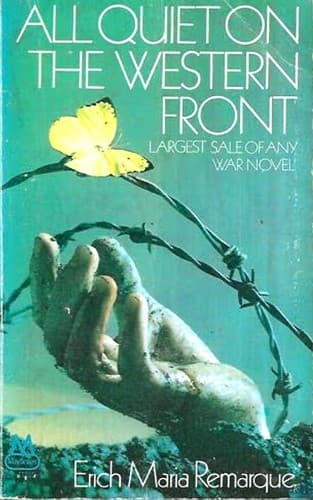
Book details and cover from Google Books.
Ready to read All Quiet on the Western Front?
Get your copy on Amazon, or listen to it on Audible. We earn a commission if you buy through these links.