
We earn a commission if you buy through these links. Learn more
alias Grace
Atwood turns a real 1843 Canadian murder case into a slow, unsettling question about memory, class, and who gets to tell a story, with no tidy verdict at the end.
What It's About
Alias Grace, published in 1996, is a historical novel built on a real case. In 1843 in Canada West, a servant named Grace Marks was convicted alongside James McDermott for the murders of their employer, Thomas Kinnear, and his housekeeper, Nancy Montgomery. Atwood takes that outline and asks what the surviving record cannot tell us.
The story moves between two voices. Grace tells her own version in the first person, drifting through childhood, emigration, and years of service, with a memory that is sometimes sharp and sometimes conveniently blank. Dr. Simon Jordan, a young physician interested in dreams and the new science of mesmerism, is trying to get at the truth, and his sections are written in the third person. Each section opens with the name of a quilt pattern, a hint about the novel's interest in stories pieced together from fragments.
Reading it feels like sitting across a table from someone who may be lying, or may be telling the truth in a way the courts never allowed. The book is patient, atmospheric, and more absorbed in the texture of nineteenth-century life and the mechanics of storytelling than in a fast-moving whodunit. Atwood's prose is clean and wry, and the central question is one you carry with you rather than a puzzle you solve.
Read this if you…
- want a literary historical novel that treats a real crime as a question about memory and power
- enjoy a mystery where the narrator is the puzzle and no final answer is promised
- like Atwood's clear, ironic prose and her interest in women's lives under constraint
Skip it if you…
- want a fast-paced crime story with a clear solution or a satisfying verdict
- find slow, detail-heavy historical fiction tiring
Key Ideas
- 1
Memory as an unreliable narrator
Grace's account is shaped by what she chooses to remember, what she forgets, and what she suspects her listener wants to hear. The novel keeps you aware that every version is a performance, so you read her testimony the way a careful historian would read any personal document, weighing gaps as closely as claims.
- 2
Who controls the telling of a story
Jordan holds the power of the interviewer, and Grace holds the knowledge of what happened. The tension between them raises questions about class, gender, and professional authority. Atwood asks how a woman with little social standing can make her version heard when men with degrees and newspapers are shaping the public story.
- 3
Pseudoscience and the Victorian mind
Mesmerism, hypnosis, and the study of dreams sit at the edge of respectable medicine. Atwood uses these fashionable ideas to probe how much of an investigation depends on belief. Readers who enjoy the history of science will find the period's confident mix of insight and quackery especially absorbing.
- 4
Public appetite for a notorious crime
The case drew crowds and sensational press coverage, and the novel shows how a murder becomes entertainment and a referendum on the accused's character. The gap between the public's certainty and the private doubt is one of the book's quieter, more pointed concerns.
- 5
Patchwork structure and fragmented storytelling
The quilt-pattern titles and the alternating voices mirror the way the story is assembled from scraps of testimony, letters, and reports. The form itself makes the point that a historical narrative is a constructed object, which gives the novel a distinctive shape that rewards attention.
Limitations
Some readers find Jordan's sections less compelling than Grace's, and his investigation can feel repetitive. The mesmerism strand reads as dated to some, and the novel's pacing is deliberate enough to test patience. Because the book refuses to settle the question of guilt, readers who want a definitive answer may feel shortchanged. Atwood's Grace is also a speculative creation built on sparse sources, so the novel should be read as fiction that draws on history rather than a reliable account of what happened.
Questions Readers Ask
- Is Alias Grace based on a true story?
- Yes. It is loosely based on the 1843 case of Grace Marks and James McDermott, who were convicted of murdering their employer and his housekeeper in Canada West. Atwood drew on the historical record, but Grace's voice, her memories, and her relationship with Jordan are invented, so the novel imagines the inner life that the documents leave out.
- How does it compare to The Handmaid's Tale?
- The Handmaid's Tale is a dystopian novel with a driving plot and a clear political warning. Alias Grace is quieter and more restrained, set in the past and focused on a single mystery and a single woman's testimony. If you liked Atwood's control of tone and her interest in women's constraints, you will likely appreciate it, though it moves at a slower pace.
- Is it still worth reading today?
- Yes, especially if you are interested in how stories about women are told and believed. Its questions about memory, testimony, and social judgment remain current. The historical details and the mesmerism subplot feel period-specific, but the central tension between what a person says and what the public accepts has not aged.
- Published
- 1996
- ISBN
- 9783442723430
- Difficulty
- intermediate
- Category
- Fiction
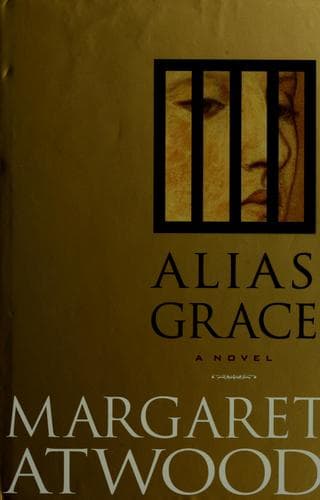
Book details and cover from Google Books.
Ready to read alias Grace?
Get your copy on Amazon, or listen to it on Audible. We earn a commission if you buy through these links.