
We earn a commission if you buy through these links. Learn more
Algorithms unlocked
A short, plain-English introduction to how algorithms work, written by a co-author of the standard university textbook, with almost no heavy math for readers starting out.
What It's About
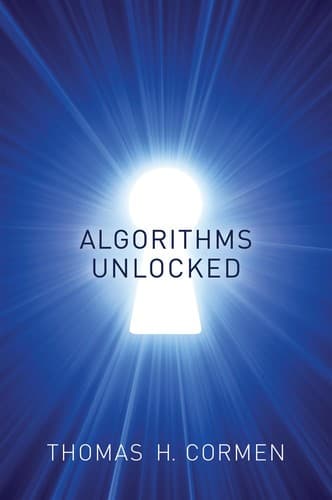
Algorithms Unlocked is a short, general-audience introduction to algorithms by Thomas H. Cormen, a computer scientist best known as a co-author of the standard university textbook Introduction to Algorithms. This book is deliberately the opposite of that textbook: few proofs, little notation, and a modest page count. Cormen uses everyday situations to explain what an algorithm is, a set of steps that reliably solves a problem, and why some methods for the same problem are far faster than others.
The book works through familiar territory: finding things in lists, putting items in order, planning routes through a network, and the way a search engine decides which pages matter. Each topic starts from a concrete problem, so you see a naive approach, why it becomes expensive, and what a better method looks like. Cormen also touches on the role of algorithms in compression and secrecy, though these parts are sketched rather than developed in depth.
Reading it feels like a patient explanation from someone who knows the subject well and wants you to see why it matters. You need little beyond comfortable arithmetic and a willingness to follow a step-by-step argument. It works well read straight through over a few evenings, with paper nearby for the small examples.
Read this if you…
- want a gentle, non-mathematical introduction before tackling harder texts on algorithms
- are curious how maps, search engines and other everyday tools make their choices
- are a programmer or student who uses algorithms daily and wants the intuition behind them
Skip it if you…
- need rigorous proofs, pseudocode and exercises for a university course; a textbook like Introduction to Algorithms will serve you better
- already know core data structures and want new, advanced material
Key Ideas
- 1
An algorithm is a recipe with a cost
The book treats an algorithm as a precise, finite procedure whose value depends on how much work it demands as the input grows. Correctness is only the first requirement. Cormen wants readers to think about how a method scales, because a solution that works on ten items may collapse on ten million.
- 2
Efficiency beats faster hardware
A central lesson is that a better method usually matters more than a faster computer. Cormen shows how an approach that examines every item can be replaced by one that narrows the search at each step. The gap between these two approaches grows dramatically with the size of the problem, which is why the choice of method has real consequences.
- 3
Searching and sorting as foundations
Searching and sorting serve as the book's teaching cases because they are simple to state and rich in ideas. Through them, readers meet the strategy of dividing a problem into smaller pieces and reusing the results of earlier steps. These patterns recur throughout computing, so the early chapters pay off well beyond the specific examples.
- 4
Networks, routes and ranking pages
Many real problems can be modeled as networks of points joined by links, such as roads, connections, or hyperlinks between web pages. Cormen explains how ideas for finding shortest routes and ranking nodes by importance can be understood without advanced mathematics. This section shows how abstract methods underlie everyday tools like navigation and search.
- 5
Hidden roles in secrecy and compression
The book briefly shows that algorithms also shape how information is shrunk for storage and how it is protected from prying eyes. These discussions are meant to reveal the reach of the subject rather than to teach the techniques in full. Readers who want to understand these areas properly will need a more specialized follow-up.
Limitations
The book is intentionally broad and shallow, so it cannot give you the depth needed to implement or analyze algorithms yourself. It includes no real code and few exercises, which some readers find frustrating. Coverage stops well short of today's large areas such as machine learning and distributed systems. Some examples simplify real situations for clarity, and readers who expected a challenging read may find the pace too light.
Questions Readers Ask
- Do I need to know programming to read Algorithms Unlocked?
- No. The book explains ideas in plain language and uses everyday examples rather than code. Some curiosity about how computers handle information helps, and basic arithmetic is enough for the examples. Programmers will likely find it a useful refresher on the reasoning behind methods they already use, while newcomers can follow it without prior study.
- How does it compare to Introduction to Algorithms?
- Introduction to Algorithms is a comprehensive, rigorous university textbook with proofs, pseudocode and many exercises. Algorithms Unlocked is much shorter and gentler, aimed at general readers who want the core ideas without the formal machinery. Many people read this book first and then move to the textbook if they want to go deeper.
- Published
- 2013
- ISBN
- 9780262313216
- Difficulty
- beginner
- Category
- Tech
Book details and cover from Google Books.
Ready to read Algorithms unlocked?
Get your copy on Amazon, or listen to it on Audible. We earn a commission if you buy through these links.