
We earn a commission if you buy through these links. Learn more
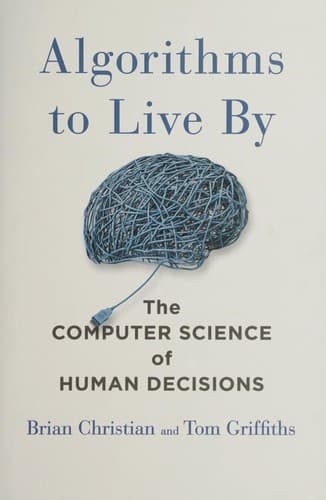
Algorithms to Live By
by Brian Christian, Tom Griffiths
Christian and Griffiths use computer science algorithms, like explore-versus-exploit and the 37% rule, to frame everyday choices. Find out who will enjoy it.
What It's About
Algorithms to Live By argues that the problems computer scientists have long worked on, such as how a computer decides what to keep in fast memory, how it orders tasks, and when it should stop searching, closely resemble decisions people face daily. Brian Christian writes for general readers, and Tom Griffiths brings the perspective of a cognitive scientist who studies how minds handle limited time and information. Together they translate technical ideas into plain language and apply them to topics like whom to date, how long to keep looking for a home, how to manage a to-do list, and when to change a long-held habit.
The approach is essay-driven rather than textbook-driven. Each chapter takes a core concept, explains the intuition behind it, and then tests it against human situations and psychological research. The math stays light, so you will follow the reasoning without needing to work through equations, though the authors do not shy away from the trade-offs that make these problems hard.
Reading it feels like a conversation with two curious guides who are enthusiastic about an idea but willing to say where it breaks down. It is brisk and often surprising, and it rewards readers who like to think about their own habits in a new way.
Read this if you…
- want practical frameworks for everyday decisions and enjoy seeing ideas from computing applied to life
- are curious about how the mind handles limited time and imperfect information
- like popular science that explains concepts through many short, concrete examples
Skip it if you…
- want a rigorous, equation-heavy introduction to algorithms or computer science
- expect a self-help book with step-by-step instructions for changing your life
Key Ideas
- 1
Explore versus exploit
Every choice between trying something new and sticking with what works involves a trade-off. The book shows how computer scientists balance these options and why the best strategy usually depends on how much time remains. It reframes restaurant picks, career moves, and routine decisions as a question of how long your horizon is.
- 2
Knowing when to stop looking
The optimal stopping problem asks when to settle on a choice when options arrive one at a time and you cannot go back. The authors explain why an early cutoff, followed by picking the next best option that beats it, performs surprisingly well. They use this to think about hiring, apartment hunting, and other searches with a deadline.
- 3
Why the messy world defeats perfect plans
Many real problems are computationally intractable, meaning no fast method guarantees the best answer. The book explains the value of relaxing constraints, accepting good-enough solutions, and using simple heuristics. It makes a persuasive case that imperfect shortcuts are often a sign of intelligence, not a failure of it.
- 4
Overfitting and the cost of overthinking
A model that fits past data too closely can perform badly on new cases. The authors connect this to human tendencies to overanalyze, to hold onto overly specific rules, and to mistake noise for pattern. They suggest that a deliberate dose of simplicity can improve judgment.
Limitations
Some applications stretch the models further than the evidence supports, and a few examples feel more like analogies than proofs. Readers may find the optimal solutions it describes assume tidy conditions that rarely hold in real life, such as known probabilities or fixed options. Coverage of certain topics feels brief, and the chapter-by-chapter structure can make the book feel more like a survey than a single argument. Some critics find the tone a little too pleased with its own cleverness.
Questions Readers Ask
- Is Algorithms to Live By a good book for people who don't know computer science?
- Yes. The authors assume no technical background and explain each concept through everyday situations. You will not need to know programming or advanced math. Some ideas take a second read to fully absorb, but the core arguments are accessible to general adult readers.
- Is the book still relevant today?
- Largely, because the core ideas about trade-offs, limited information, and search strategies are timeless. Some examples reflect the mid-2010s, and technology has moved on, but the reasoning still applies. Readers who want current research on decision-making may want to supplement it with newer work.
- Published
- 2016
- ISBN
- 9781480560406
- Difficulty
- beginner
- Category
- Tech
Book details and cover from Google Books.
Ready to read Algorithms to Live By?
Get your copy on Amazon, or listen to it on Audible. We earn a commission if you buy through these links.