
We earn a commission if you buy through these links. Learn more
Algorithms
A code-first tour of the algorithms behind sorting, searching, and graph problems, where every method is implemented, tested, and analyzed for real performance.
What It's About
Sedgewick's Algorithms is a textbook-style survey of the methods programmers use to sort, search, and organize data, and to solve problems on graphs and strings. It is adopted as a core text in many university courses, and it is written for people who want to write working code, not just recognize algorithm names. Each topic comes with a Java implementation, an explanation of why it works, and an account of how its running time grows as the input gets larger.
The style is careful and mathematical without being impenetrable. Sedgewick leans on empirical testing and simple models of cost, so claims about speed are backed by experiments and operation counts rather than asserted on authority. Exercises range from quick checks to open-ended problems, and the companion website hosts code, data, and supplementary material. Reading it feels less like browsing a catalogue and more like working through a course with a patient instructor.
The experience is demanding but rewarding. You need comfort with basic programming and some algebra, and you should expect to pause, run code, and check your own reasoning. Readers who work through the exercises come away able to choose an algorithm for a real problem and explain the trade-off behind the choice. Readers who only want a quick reference will find the book thorough but heavier than they need.
Read this if you…
- want to learn algorithms by implementing and measuring them yourself
- are preparing for a computer science course or technical work that expects real depth
- already write code and want to understand why one approach beats another
Skip it if you…
- want a light, story-driven history of computing or a shallow overview of algorithms
- are looking for a language-agnostic conceptual book with no code to read through
Key Ideas
- 1
Performance is something you can measure
The book treats running time as an observable quantity. It shows how to count the basic operations an algorithm performs, how to build a simple model of its cost, and how to check that model with timed experiments. This habit of predicting and then testing is one of the most transferable things you take away, because it applies to any code you write, not only the methods covered.
- 2
Fundamental data structures come first
Before sorting or searching, the book builds the basic containers that nearly every later method depends on, such as stacks, queues, and linked structures. It also covers ideas like union-find, which handles grouping and connectivity questions efficiently. Seeing these building blocks clearly makes the later chapters much easier to follow and shows why the same few tools reappear across very different problems.
- 3
Sorting and searching are a family of trade-offs
Rather than presenting one best sorting method, the book compares several, each with different strengths on different kinds of input and memory budgets. The same pattern holds for searching, where the choice of structure determines whether lookups, insertions, and deletions stay fast. The lesson is that the right answer depends on the data and the operations you need, which is a skill more useful than memorizing a single winner.
- 4
Graphs as a unifying model
Many practical problems, from routing and scheduling to dependency resolution, become easier to think about once they are expressed as graphs. The book covers how to represent graphs, how to search them, and how to find paths and connections efficiently. Treating the graph as a common language lets readers recognize the same underlying structure in problems that look unrelated on the surface.
- 5
Implementation details decide real speed
The book repeatedly shows that two methods with the same theoretical growth rate can perform very differently in practice because of memory access patterns, constant factors, and careful coding. Its code-first approach keeps these details visible. Readers learn that a correct algorithm is only the start, and that thoughtful implementation is part of what makes software fast and dependable.
Limitations
The code is written in Java, and the edition most readers find is the later one from the early 2010s, so some library choices and conventions feel dated. Readers who work in other languages will need to translate the ideas. The graph and string chapters are dense, and the mathematical analysis assumes patience with notation. The book also does not cover modern areas such as machine learning, distributed systems, or large-scale data processing, so it is a foundation rather than a complete map of current practice.
Questions Readers Ask
- Is Algorithms by Sedgewick still relevant today?
- Yes, for the fundamentals. Sorting, searching, union-find, and graph algorithms change slowly, and the analysis methods remain sound. Some code examples and surrounding material reflect the period when the book was written, so expect to adapt details for modern languages and hardware. The core reasoning still holds up well.
- How does it compare to Introduction to Algorithms by Cormen et al.?
- Cormen and colleagues write in language-neutral pseudocode and go deeper into formal proofs, which suits theory-minded readers. Sedgewick is code-first and emphasizes experiments and measured performance. If you want to write and test programs, Sedgewick is often the more practical choice; if you want rigorous theory, the other book is usually stronger.
- Published
- 2011
- ISBN
- 9780321573513
- Difficulty
- intermediate
- Category
- Tech
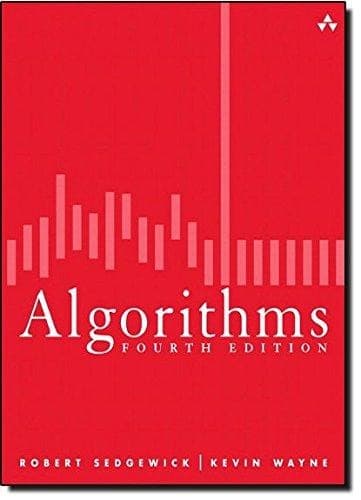
Book details and cover from Google Books.
Ready to read Algorithms?
Get your copy on Amazon, or listen to it on Audible. We earn a commission if you buy through these links.