
We earn a commission if you buy through these links. Learn more
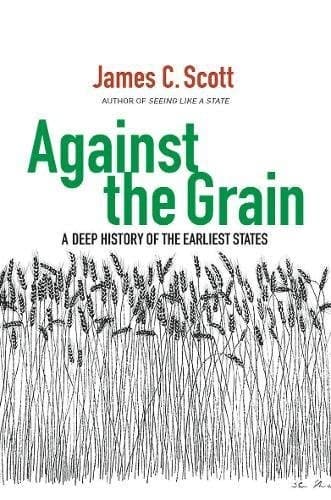
Against the Grain
James C. Scott makes a provocative case that the first states rested on grain, crowding, and disease, and were fragile from the start, which reframes the familiar story of civilization's rise.
What It's About
Against the Grain is James C. Scott's attempt to retell how the earliest states formed in Mesopotamia, several thousand years before the common era, and why they were so unstable. Scott, a political scientist and anthropologist at Yale, builds the book as a synthesis of archaeology, ecology, and history rather than around a single new discovery. The result is a dense, argumentative work that asks readers to set aside a tidy story of steady human progress.
The method is to follow the material: what people ate, where they lived, which animals and diseases came with settled life, and how rulers extracted labor and taxes. Scott gives special attention to cereal grains as the basis of early state finance, arguing that grain was easy to measure, store, and seize, and that it pushed rulers to keep people in one place and at work. Reading it feels like being walked through a long, opinionated argument, with frequent detours into evidence and sharp asides about received wisdom.
Expect a demanding read. Scott writes clearly and often wryly, but the book moves quickly between disciplines and assumes you can hold several threads at once. It rewards patience with a changed view of why early civilization looked the way it did and why its achievements came with real costs.
Read this if you…
- want a skeptical, big-picture account of how civilization began
- enjoy argumentative history that challenges the standard story of progress
- are curious how environment, food, and disease shaped political power
Skip it if you…
- want a straightforward narrative of ancient kings, empires, and battles
- are looking for a light, quick read or a practical guide
Key Ideas
- 1
Settled life came before farming
Scott argues that sedentary communities formed before full-scale agriculture in some places, because hunting, fishing, and gathering in rich environments could support people who stayed put. This challenges the assumption that farming created settlement and that settlement created the state. Seeing the order differently changes how the rise of early governments looks.
- 2
Grain as the foundation of the early state
Cereals such as barley and wheat were valuable to rulers because their yields could be counted, stored, and taxed in a way that mobile or scattered resources could not. Scott calls this a kind of staple finance and argues it shaped who held power and how they used it. The argument links agriculture directly to political control.
- 3
Early states were fragile and prone to collapse
Dense populations living on a few crops were vulnerable to failed harvests, epidemics, and conflict, so early states often broke down. Scott treats collapse as a recurring feature of state history rather than an unusual failure. This is one of the book's most striking reframings of the ancient record.
- 4
Crowding brought new diseases and dependence
Living close together with livestock and stored food created conditions for epidemic disease, and people in these settings could become dependent on the authorities that organized their food supply. Scott uses this to explain why early states were both productive and precarious. The cost of civilization, in health and freedom, is a central theme.
- 5
Outsiders as refuge, not relics
Scott suggests that people living beyond state control were not simply primitive survivors of an earlier age. Some may have chosen mobility and distance from state demands, and some may have fled existing states. This reading treats the margins of early civilization as a relationship with the state rather than a lag behind it.
Limitations
Critics point out that Scott synthesizes a large body of archaeology, and some of his interpretations of early settlement, population, and collapse are contested by specialists. The book is sweeping and sometimes repetitive, and its focus falls mainly on Mesopotamia and the early Near East rather than the wider world. Readers wanting a balanced survey of competing scholarly views should read it alongside other accounts.
Questions Readers Ask
- Who is Against the Grain best for?
- It suits readers who already know the basics of ancient history and want a provocative argument about how early states formed. It is less suited to readers looking for a chronological story of rulers and wars. Those interested in how economics and environment shape politics will find it especially rewarding.
- How does it compare to Guns, Germs, and Steel?
- Both books take a large-scale, environmental view of why some societies developed states and others did not. Scott is narrower in scope, focused on early Mesopotamia and the grain-based state, and he is more openly contrarian. Readers who liked Diamond's sweep may find Scott's argument sharper but less comprehensive.
- Is the book still relevant today?
- Yes, because its questions about dependence, taxation, disease, and the costs of settled life remain pressing. Some archaeological details have been revised since publication, so it is worth checking specialist sources for specific claims. As an argument about how states work, it still offers a useful lens.
- Published
- 2017
- ISBN
- 9783518299340
- Difficulty
- intermediate
- Category
- History
Book details and cover from Google Books.
Ready to read Against the Grain?
Get your copy on Amazon, or listen to it on Audible. We earn a commission if you buy through these links.