
We earn a commission if you buy through these links. Learn more
Accelerando
Stross's sharp, fast-moving vision of the near-future singularity, following one family through uploaded minds, runaway companies, and a cat-shaped AI, is worth reading for anyone who likes big ideas delivered with humor.
What It's About
Accelerando is a set of linked stories rather than a single tidy plot. It follows one loosely connected family across roughly three generations, as technology speeds up faster than anyone can plan for. The book opens in a recognizable near-future world of cheap computing and wild startups, then keeps shifting its ground: minds get copied and uploaded, companies start behaving like autonomous agents, and the physical world is reorganized around computation.
Stross writes in a brisk, sardonic voice, closer to a tech satirist's than a sermonizer's. He drops readers into jargon and assumes they will keep up, and he often pauses to poke fun at venture capital, open source culture, and the people chasing the next gadget. Chapters jump in time and point of view, so reading feels like being carried along by a current rather than walked through a scene. Some sections are more story than essay, while others are close to pure speculation.
The result is less a novel with a single arc than an argument delivered at speed. It rewards readers who enjoy ideas and are willing to get lost for a while. It can feel exhausting to those who want stable characters or a steady narrative line.
Read this if you…
- enjoy big speculative ideas about AI, uploads, and the economy and don't mind being dropped in at the deep end
- like satire of tech culture and startup hype delivered with a sardonic edge
- want a fast, episodic read that covers decades rather than a single tightly plotted story
Skip it if you…
- need consistent characters and a clear, linear plot to stay engaged
- find heavy jargon and rapid shifts in time and viewpoint tiring rather than exciting
Key Ideas
- 1
Intelligence outpacing the people who built it
The book's central engine is acceleration: computation doubles on itself until human planning falls behind. Stross is less interested in a single dramatic moment of machine awakening than in the uncomfortable sense that events keep getting ahead of everyone, including the characters who think they are steering them. That gradual loss of control is the thread that ties the stories together.
- 2
Corporations as slow, alien minds
One of the sharpest ideas here is that companies already behave like non-human intelligences, optimizing for goals that no individual person fully controls. Stross extends this into the future, asking what happens when such entities gain better tools. The concept gives a satirical edge to the business chapters and makes familiar corporate logic feel newly strange.
- 3
Identity and the problem of copies
As minds can be copied, backed up, and run in new substrates, the book keeps asking what counts as the same person. These questions are handled through practical consequences, such as ownership, inheritance, and legal status, rather than long philosophical debate. The effect is to make abstract puzzles about selfhood feel like everyday problems.
- 4
A restless, comic voice carrying dense speculation
What makes the storytelling distinctive is its tone. Stross mixes jokes, cultural references, and hard technical detail, often within the same paragraph. That keeps the heavy material moving and gives the book an energy that many more solemn science fiction works lack, though it also means the humor can wear thin for some readers.
Limitations
Many of the gadgets, companies, and cultural references are tied to the early 2000s, so parts of the book now read as period pieces. Characters are often more vehicles for ideas than fully developed people, and some readers find the cast hard to care about. The rapid episode-to-episode structure can make the book feel uneven or unfocused, and the ending is more an open flourish than a resolution. Critics also note that the humor sometimes tips into smugness about the tech world it is satirizing.
Questions Readers Ask
- Is Accelerando a novel or a collection of stories?
- It is best described as a set of linked stories that together form a novel. Each section can be read as a self-contained episode, but they share a family, recurring ideas, and a continuous sense of technological change. Readers who expect a single continuous plot may find the structure disorienting at first, but it is part of how the book builds its scope across decades.
- Do I need a technical background to enjoy it?
- No specialist knowledge is required, but a comfort with computing terms and a willingness to look things up helps. Stross rarely stops to explain his ideas, so you will get more from it if you can follow the general logic of software, networks, and markets. Readers without that background can still enjoy the satire and the sheer inventiveness.
- Published
- 1900
- ISBN
- 9780441014156
- Difficulty
- advanced
- Category
- Tech
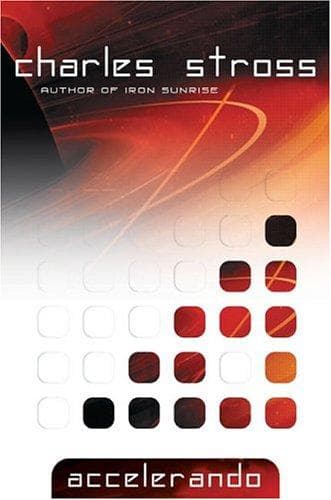
Book details and cover from Google Books.
Ready to read Accelerando?
Get your copy on Amazon, or listen to it on Audible. We earn a commission if you buy through these links.