
We earn a commission if you buy through these links. Learn more
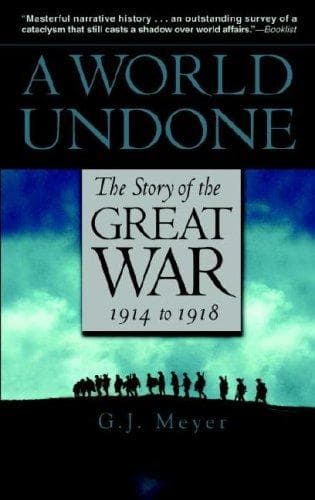
A World Undone
by G. J. Meyer
A sweeping, chronological narrative of World War I that keeps every front and every decision-maker in view, ideal for readers wanting the whole war in one readable book.
What It's About
A World Undone is a single-volume narrative history of the First World War, running from the assassination at Sarajevo in 1914 to the armistice of November 1918. Meyer moves through the years in order and keeps the war's major theaters in view at once: the trenches of France and Flanders, the fighting on the Eastern Front, the campaigns in the Balkans, the Middle East, and at sea. Readers who have only a vague sense of how these fronts connected will find the big picture clarified.
His approach leans on the choices of statesmen and commanders. Much of the attention goes to why governments kept fighting, how generals planned their offensives, and what those plans cost in lives and in political standing. The prose is brisk and forward-moving, closer to a storyteller's pace than to an academic survey, and Meyer is willing to make pointed judgments about who bore responsibility for particular disasters.
Reading it feels like being walked through a catastrophe in sequence, with the bitter outcome always partly visible in the background. The book is long and dense with battles, names, and dates, so the experience is more immersive than reflective. If you want a short introduction or an analysis of the war's cultural afterlife, this will feel heavier than you need.
Read this if you…
- want the whole war in one connected narrative, from the July crisis to the armistice
- enjoy detailed accounts of military and political decision-making
- prefer a strong narrator with clear opinions over a neutral survey
Skip it if you…
- want a short introduction you can finish in a weekend
- are mainly interested in soldiers' everyday experience or the home front
Key Ideas
- 1
Decisions made by the men in charge
Meyer puts statesmen and generals at the center of the story. He repeatedly shows how rigid mobilization timetables, confident war plans, and personal judgment shaped events, suggesting the catastrophe was not an inevitable force of nature but the product of choices that could have gone differently.
- 2
Why the fighting dragged on so long
A recurring question is why the war did not end sooner. The book traces how each side kept believing that one more offensive would break the deadlock, and how repeated failures made it harder for any government to be the first to seek a negotiated peace.
- 3
The war beyond the Western Front
Although the trenches of France and Belgium dominate popular memory, the narrative gives real weight to the Eastern Front, the Balkans, the Ottoman campaigns, and naval warfare. This widens the picture and shows how the fronts influenced one another.
- 4
How the peace set up later conflict
The final chapters of the story look past the armistice to the settlement that followed. Meyer connects the collapse of old empires and the postwar arrangements to the unrest of the following decades, so the war reads as the start of a longer upheaval rather than a closed chapter.
Limitations
The book is primarily a political and military history, so it gives less space to ordinary soldiers, civilians, women's work, and the lives of colonial and non-European troops than newer social histories do. Its judgments are sharp, and some readers find them more confident than the evidence always allows. It works largely as a synthesis of existing scholarship rather than new archival research, and readers who want the latest interpretations should pair it with more recent books.
Questions Readers Ask
- Is A World Undone good for someone new to World War I?
- Yes, if you are willing to commit to a long read. Meyer explains the alliances, the July crisis, and the logic of the early campaigns clearly, so you do not need prior knowledge. Beginners may find the density of names and dates heavy in the middle chapters, and a shorter overview alongside it can help.
- How does it compare to Christopher Clark's The Sleepwalkers?
- Clark focuses mainly on the diplomacy that led to war in 1914 and argues that no single power was solely to blame. Meyer covers the whole war from start to finish, with much more attention to battles and commanders. Readers interested in the origins should consider Clark, while those wanting the full course of the war will find Meyer more complete.
- Published
- 2006
- ISBN
- 9781455153626
- Difficulty
- intermediate
- Category
- History
Book details and cover from Google Books.
Ready to read A World Undone?
Get your copy on Amazon, or listen to it on Audible. We earn a commission if you buy through these links.