
We earn a commission if you buy through these links. Learn more
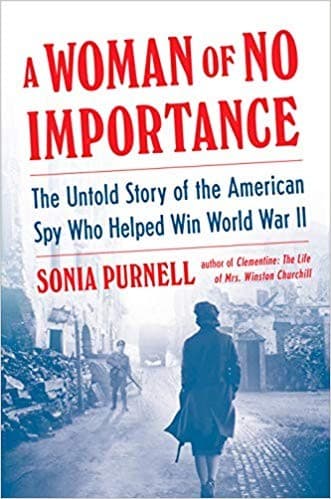
A Woman of No Importance
Guide by the Books of the Day editors · Updated · How we write our guides
Virginia Hall's wartime story, rebuilt with a reporter's drive: an American agent who outmaneuvered the Gestapo while being dismissed as no threat at all.
What Creators Say About A Woman of No Importance
2 creators reviewed A Woman of No Importance on YouTube between 2020 and 2021, with 11.3K views between them. Their opinions are their own; we picked these reviews, we didn't write them.
What It's About
A Woman of No Importance is a biography of Virginia Hall, an American who joined Britain's Special Operations Executive and spent the Second World War supporting and directing resistance networks in occupied France. Hall had a prosthetic leg after a hunting accident, and her enemies and some of her own colleagues underestimated her because of it. She moved across France on foot, by bicycle and by train, often staying one step ahead of the Gestapo. Despite this record, she was largely forgotten after 1945, and Purnell's book tries to recover her story from the paper trail she left behind.
Purnell writes as a journalist rather than an academic historian, so the result is brisk, narrative-driven nonfiction. The pace is steady and the tone is admiring without becoming hagiographic. Where the record is thin, the narrative has to bridge gaps, so readers should expect some careful inference rather than a play-by-play of every operation. The book reads more like an adventure than a dry military history, though it does not shy away from the bureaucratic frustrations of wartime intelligence.
Reading it is less about learning battle plans than about watching one person handle fear, rivalry and institutional indifference day to day. The chapters move between Hall's work in France, her escape over the Pyrenees and her later service, so the book works both as a life story and as a portrait of clandestine work. It is easy to read in long sittings and carries real tension in its best passages.
Read this if you…
- want a true-story wartime narrative with the pace of a thriller
- are interested in women's roles in the Second World War and how they were overlooked
- enjoy biographies that show how intelligence work was done day to day
Skip it if you…
- want a detailed military history of the campaigns in France or the wider war
- need every claim fully sourced and footnoted to the standard of academic history
Key Ideas
- 1
Competence overlooked because of who she was
The book's central argument is that Hall was dismissed for being a woman, an American and a disabled person, and that these assumptions cost her opportunities while she was doing some of the most consequential work of the war. Purnell shows how the people around Hall repeatedly misjudged her, and how often that misjudgment worked in her favour, since the enemy also underrated her. The title points at this irony directly.
- 2
Life inside a resistance network
Much of the story is about the daily texture of clandestine work: recruiting people, moving messages, arranging supplies and judging who could be trusted. The danger comes less from dramatic set pieces than from the constant risk that one arrest, one careless contact or one bad guess could unravel an entire network. Readers interested in how underground organisations actually functioned will find plenty of concrete detail here.
- 3
Friction between wartime agencies
Hall's career cannot be separated from the rivalries and turf battles among British and American intelligence services. Purnell describes how bureaucratic caution, competing priorities and personal suspicion shaped who got support and who was left to fend for themselves. This gives the book a useful angle on how the organisations themselves, not only the enemy, could decide what a brave agent was worth.
- 4
Why forgotten wartime figures get erased
A quieter theme is how the historical record, including postwar memoirs and official accounts, tends to elevate certain names and leave others out. Purnell treats Hall's obscurity as something that needed explaining rather than a simple verdict on her importance. The book asks readers to consider whose contributions were recorded at the time and whose were lost.
Limitations
Some critics would say the book leans on narrative reconstruction more than on documents, so certain scenes and inner thoughts are inferred rather than proven. Readers wanting a tight analysis of the Special Operations Executive as an institution, or a broader account of other agents and networks, will need to look elsewhere. The focus is on one remarkable life, so the wider context of French resistance politics and postwar debates is touched on only briefly. The style is accessible rather than scholarly, which suits general readers but may frustrate specialists.
Questions Readers Ask
- Is A Woman of No Importance a good first book about the Second World War?
- Yes, for most general readers. It is written as narrative nonfiction, with a clear central figure and a strong sense of momentum. You will meet unfamiliar names and organisations, but the book introduces them as it goes. If you want a broader overview of the war afterwards, pair it with a general history.
- How does it compare with other books about wartime spies?
- It is closer in spirit to a character-driven adventure than to a spy-novel style account or a dense archival study. Compared with books that focus on codebreaking or grand strategy, it stays much nearer to one person's experience in the field. Readers who enjoy this approach often move on to other single-life biographies of wartime agents.
- Is the book still relevant today?
- Its subject matter remains relevant, particularly the question of how skilled people are overlooked because of who they are. The historical details are the main thing to check against newer scholarship, since research on the period has continued since publication. As a story of courage and institutional blind spots, it still reads well.
- Published
- 2019
- ISBN
- 9780349010175
- Difficulty
- beginner
- Category
- Biographies
Book details and cover from Google Books.
Ready to read A Woman of No Importance?
Get your copy on Amazon, or listen to it on Audible. We earn a commission if you buy through these links.