
We earn a commission if you buy through these links. Learn more
A widow's story
Guide by the Books of the Day editors · Updated · How we write our guides
A raw, close-up account of losing a spouse of nearly fifty years, worth reading for its unsparing honesty about grief and how it reshapes ordinary life.
What It's About
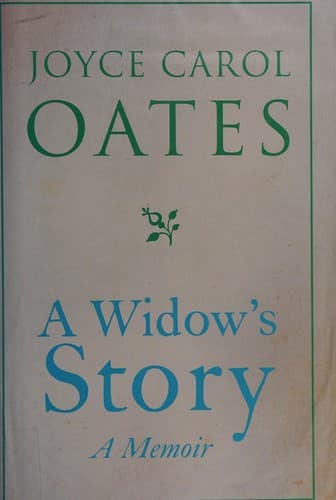
A Widow's Story is Joyce Carol Oates's memoir of the year after her husband, the literary editor Raymond Smith, died suddenly in early 2008 after nearly half a century of marriage. It begins in the hospital and moves outward, following the practical, emotional, and mental shifts that follow a death: the paperwork, the house full of his things, and the way her own sense of self had been built around a shared life. It is a memoir in the plainest sense, but it reads more like a long, searching notebook than a conventional life story.
Oates writes in a restless, self-questioning style. She returns to the same facts, tests her memories against documents, and turns often to the vocabulary of loss. She is candid about anger, confusion, and the strange detachment that can come with shock. Some passages are startlingly specific; others circle back on themselves, which is part of the point.
Reading it is an intimate and sometimes uncomfortable experience. You are invited into a private mind at its most unguarded, and the book does not offer neat consolation. It works better as an honest companion than as a guide to recovery, and it rewards slow reading.
Read this if you…
- are interested in grief written without sentimentality
- have lost a long-term partner and want an account that names the disorientation
- admire Oates's work and want to see how her mind operates on the page
Skip it if you…
- want a practical guide with steps for coping with bereavement
- prefer fiction or narrative with plot and momentum
Key Ideas
- 1
Grief as the loss of a shared self
Oates shows how a long marriage becomes a way of seeing the world, so that a death removes not only a person but a habitual 'we' that shaped daily decisions and memories. The book takes this disorientation seriously, tracing how ordinary routines and language suddenly stop making sense when one half of a partnership is gone.
- 2
The administrative weight of a death
A large part of the book deals with the logistics that arrive at the worst possible time: forms, accounts, property, and institutions that require paperwork from someone who is barely functioning. Oates treats these details as emotionally loaded rather than as background noise, which makes the grief feel grounded and physical.
- 3
Writing as a way of holding on
The act of writing is both a coping mechanism and a method of testing reality. Oates questions her own recollections, rereads his traces, and keeps returning to the page as if the words might settle something. Readers interested in how memoir can function as an investigation will find this approach especially revealing.
- 4
Refusing easy consolation
The book does not move toward a tidy emotional resolution. Its honesty about anger, doubt, and the limits of comfort is the main reason many readers find it valuable. It offers recognition rather than reassurance, which can feel either bracing or frustrating depending on what the reader needs.
Limitations
Some readers find the book repetitive, since its circling structure returns to the same moments many times. It is focused almost entirely on one marriage and one author's perspective, so it offers little on other people's experiences of widowhood or on the broader research about bereavement. Its intensity of self-examination can also be hard to sustain across its full length, and readers who did not know Oates's public life may find some references to her literary world less illuminating than intended.
Questions Readers Ask
- Is A Widow's Story useful if I am not grieving?
- Yes, as a window into how loss feels from the inside and how a long partnership shapes identity. Readers who have never been bereaved often find it clarifying. It is less useful if you want a how-to guide, since the book describes Oates's experience rather than offering a method for getting through grief.
- How does it compare to Joan Didion's The Year of Magical Thinking?
- Both are widows' memoirs about a sudden death. Didion's book is leaner and more controlled, built around a tight essayistic focus. Oates's is looser and more diffuse, with a more open-ended questioning of memory and self. Readers who liked one often appreciate the other, but Oates asks for more patience with repetition.
- Is the book still relevant?
- The grief it describes is timeless, and its honesty about disorientation has not dated. Some of the literary and academic references are specific to Oates's circle and era, so you may need to look them up. The emotional core stands on its own.
- Published
- 2011
- ISBN
- 9780007388172
- Difficulty
- intermediate
- Category
- Psychology
Book details and cover from Google Books.
Ready to read A widow's story?
Get your copy on Amazon, or listen to it on Audible. We earn a commission if you buy through these links.