
We earn a commission if you buy through these links. Learn more
A Time to Kill
by John Grisham
On screen: A Time to Kill (film, 1996)
Guide by the Books of the Day editors · Updated · How we write our guides
Grisham's first novel is a gripping courtroom drama about a Mississippi father, a young lawyer, and a town torn apart by race and rage, with stakes that feel personal from the first chapter.
What Creators Say About A Time to Kill
2 creators reviewed A Time to Kill on YouTube between 2020 and 2022, with 5.1K views between them. Their opinions are their own; we picked these reviews, we didn't write them.
What It's About
A Time to Kill is John Grisham's first novel, published in 1989 and set in a fictional Mississippi county during the late 1980s. The story begins with a crime that forces a community to confront its own history: a father takes matters into his own hands after a brutal attack on his young daughter. A struggling local lawyer, Jake Brigance, agrees to defend him, and the novel becomes a trial story where the stakes are personal, political, and racial all at once.
Grisham writes in plain, fast prose, with short chapters and frequent shifts between perspectives. You follow the defense team, the prosecutor, the families involved, and characters on the racist fringe who see the case as a cause. The courtroom scenes carry much of the weight, but the book also spends real time on the pressure Jake faces at work, at home, and in town. Grisham drew on his own years practicing law in Mississippi, and it shows in the procedural texture.
Reading it is an emotionally direct experience. It is more openly angry and more immediate than his later legal thrillers, and the depictions of violence and hatred are hard to sit through at times. Expect a book that asks its moral questions out loud rather than leaving them ambiguous, and that you will likely finish in a few long sittings.
Read this if you…
- want a fast courtroom drama with real moral stakes
- are interested in how race and violence play out in a small Southern town
- liked Grisham's style and want to see where his career began
Skip it if you…
- want a quiet, ambiguous literary novel, since this one is loud and direct about its themes
- find graphic depictions of sexual and racist violence too hard to read
Key Ideas
- 1
Justice tested by rage and race
The central question is whether a fair verdict is possible in a place where the law, the juries, and the local power structure were shaped by white dominance. The novel treats the courtroom as a fragile place where justice has to be argued for, not assumed.
- 2
A lawyer forced to choose a stand
Jake is not a hero from the start. He is a mostly broke, uncertain attorney who has to decide what the case will cost him in money, reputation, and safety. His arc asks what a person owes to an unpopular client and to his own conscience.
- 3
A town defined by its silence
Much of the menace comes from ordinary people who stay quiet, look away, or quietly take sides. The trial becomes a referendum on the whole community, and the book is sharp about how polite neighbors can enable harm.
- 4
The courtroom as the story's engine
Grisham builds tension through cross-examinations, strategy meetings, and procedural obstacles. The legal details are dramatized for pace, but they give the reader a clear sense of how much hangs on a single witness, a single ruling, or a single jury.
Limitations
Critics often note that the characters are drawn in broad strokes, with villains who can feel cartoonish and heroes who speak in speeches. The prose is workmanlike and sometimes repetitive, and the story leans on melodrama. Racial politics are filtered largely through a white lawyer's point of view, so Black characters have less interior life than the white ones. Some legal procedure is simplified for drama, and the book's attitudes reflect its 1989 origins.
Questions Readers Ask
- Is A Time to Kill the same story as the 1996 movie?
- The 1996 film adaptation, starring Matthew McConaughey and Samuel L. Jackson, follows the core story of the novel. The book has more subplots, more time inside the town's politics, and more interior perspective from the supporting characters, so the film compresses a lot of material.
- How does it compare to The Firm or The Pelican Brief?
- It is more emotionally raw and rooted in a single town than those corporate and conspiracy thrillers. The plotting is less polished, but the stakes feel more personal, and the courtroom sections are central rather than a backdrop to a larger intrigue.
- Is the book still relevant today?
- Its concerns about racial violence, jury bias, and community complicity remain widely discussed. Readers should expect period attitudes and a 1980s Southern setting, but the core questions about justice and fairness still resonate.
- Published
- 1989
- ISBN
- 9780553745191
- Difficulty
- beginner
- Category
- Mystery & Thriller
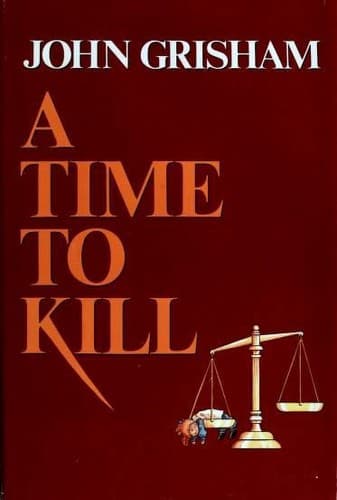
Book details and cover from Google Books.
Ready to read A Time to Kill?
Get your copy on Amazon, or listen to it on Audible. We earn a commission if you buy through these links.