
We earn a commission if you buy through these links. Learn more
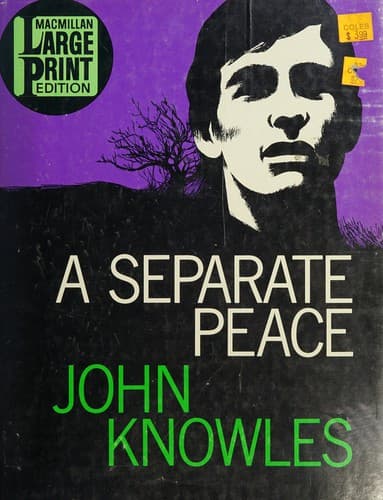
A Separate Peace
by John Knowles
Guide by the Books of the Day editors · Updated · How we write our guides
A Separate Peace is a short, precise novel about a boarding-school friendship and the envy inside it, told by a narrator who is slowly admitting what he did, making it a rewarding read for anyone who likes stories about self-deception.
What Creators Say About A Separate Peace
2 creators reviewed A Separate Peace on YouTube between 2016 and 2019, with 44.8K views between them. Their opinions are their own; we picked these reviews, we didn't write them.
What It's About
A Separate Peace is a short novel set at Devon, a fictional New England boarding school, during the Second World War. Gene Forrester, now an adult, returns in memory to the year he spent there as a student and to the friendship at the center of it: his intense, charismatic classmate Phineas, a gifted athlete whose easy warmth makes everything seem effortless. Knowles, who drew on his own years at a prep school, builds the story around a small, painful moment between two boys rather than around the war, which is present mostly as rumor and a looming draft notice.
The approach is first-person and retrospective, and that is the book's engine. Gene is not a reliable narrator in the usual sense. He is trying to understand what he did and why, and the reader watches him circle the same events with growing honesty. The prose is clean and controlled rather than showy, with long reflective passages that slow the pace. Expect a book that rewards attention to what Gene says about himself as much as to what happens.
Reading it is more unsettling than comforting. It is short enough to finish in a few sittings, but it lingers, partly because its questions about envy, loyalty and the stories we tell ourselves never resolve neatly. Many readers meet it as an assigned school text, but it reads differently as an adult, when the distance between the narrator and his younger self becomes part of the point.
Read this if you…
- want a short literary novel about jealousy and friendship with a narrator who is hard to trust
- are interested in how coming-of-age stories handle guilt and self-deception
- prefer quiet, reflective prose to fast plotting
Skip it if you…
- need a fast-moving plot or lots of action
- want the war front and center, since here it stays in the background
Key Ideas
- 1
Admiration that curdles into envy
The novel's central tension is the way affection and resentment live side by side in Gene's feelings toward Phineas. Knowles shows how someone can genuinely love another person and still feel diminished by them. Gene's jealousy is never simple villainy; it is ordinary, human and easy to misread, which is why the book stays uncomfortable long after the last page.
- 2
A friendship that is both real and harmful
The bond between the two boys is warm, funny and sincere, and the book takes it seriously rather than treating it as a setup. That sincerity is what makes the damage it contains so hard to look at. Knowles asks whether a relationship can be genuinely good for one person and genuinely corrosive for the other at the same time.
- 3
A war felt from a distance
World War II reaches Devon mostly through news, rumor and the promise of military service, and the boys often treat it as something happening elsewhere. This gap between the wider world and the school's insulated routines gives the novel its unusual atmosphere. The war matters as pressure and deadline rather than as a battlefield story.
- 4
Memory as self-justification
Because Gene is narrating years later, the reader has to weigh what he chooses to reveal, what he rationalizes and what he seems unable to face. The storytelling is a slow process of self-examination, and the gaps and hedges are as informative as the events themselves. It is a demanding but rewarding way to think about how people explain their own past.
Limitations
The setting is an all-male, privileged school, and women barely appear, so the world feels narrow by design and some readers find it limiting. The pace is slow, and Gene's self-analysis can feel repetitive to readers who want more event and less introspection. Its attitudes toward class, privilege and masculinity feel dated in places. It is also not a war novel, despite the wartime setting, and readers expecting combat or historical detail will be disappointed.
Questions Readers Ask
- Is A Separate Peace still worth reading today?
- Yes, especially if you want a compact novel about envy and self-deception. Its prose is direct and its central questions about how we justify our own worst moments have not aged. Some of its social assumptions feel dated, but the emotional core still lands with adult readers who return to it.
- How does it compare to The Catcher in the Rye?
- Both are narrated by young men looking back at school and a painful loss of innocence. Holden's voice is loud, digressive and funny, while Gene's is measured and quietly self-questioning. Readers who liked Holden's honesty may find Gene's evasions more unsettling, and the two books work well as companion reads.
- Published
- 1959
- ISBN
- 9780606341608
- Difficulty
- beginner
- Category
- Education
Book details and cover from Google Books.
Ready to read A Separate Peace?
Get your copy on Amazon, or listen to it on Audible. We earn a commission if you buy through these links.