
We earn a commission if you buy through these links. Learn more
A Sand County Almanac
by Aldo Leopold
Guide by the Books of the Day editors · Updated · How we write our guides
Aldo Leopold's short, observant essays on a worn-out Wisconsin farm and the land ethic he proposed to replace the idea of land as property. Brief, humane, and still one of the core texts of conservation.
What Creators Say About A Sand County Almanac
2 creators reviewed A Sand County Almanac on YouTube between 2018 and 2024, with 6.6K views between them. Their opinions are their own; we picked these reviews, we didn't write them.
What It's About
A Sand County Almanac was published in 1949, a year after Leopold died, and it gathers his writing from the last decades of his life. The first part is a set of monthly sketches written at a shack on a rundown farm in the sand country of central Wisconsin, where he and his family worked to restore the land. Each month he notes what is blooming, which birds have arrived, how the soil and water are behaving, and what the change of season reveals about the place. A second group of essays moves outward to other landscapes, and a final section lays out the philosophy that gives the book its lasting reputation.
The writing is plain, precise, and patient. Leopold rarely raises his voice. He describes a single marsh, a flight of geese, or a stand of prairie plants with the attention of a trained scientist and the warmth of someone who simply likes being outdoors. The sentences are short and concrete, so the book can be read in small doses, a few pages at a time, without losing its thread.
Labeled History in many catalogues, the book is really nature writing and environmental philosophy, with history working in the background as a record of what the land lost and what it might recover. Reading it feels like walking slowly beside an experienced observer who keeps pointing at things you would otherwise miss.
Read this if you…
- want a short, classic introduction to conservation thinking and ecological attention
- enjoy quiet nature writing that rewards slow, repeated reading
- are interested in how people can take responsibility for the land they own or use
Skip it if you…
- want a current, data-driven account of climate change or modern environmental policy
- need a tightly structured argument or a narrative with a strong plot
Key Ideas
- 1
Land as a community, not a commodity
Leopold argues that ethics has so far covered people and, at most, domestic animals, while the soil, water, plants, and wild animals that sustain us have been treated as property to be used up. He proposes widening the circle of moral concern so that the health of the whole biotic community becomes a standard for judging what is right in land use. The idea is abstract in places, but the book keeps returning to concrete examples of land treated well and badly.
- 2
Seeing the land as a working whole
Much of the book trains the reader to notice connections: how a fire, a drought, a grazing animal, or a missing predator ripples through plants, insects, birds, and soil. Leopold writes about ecology before the word was common in public life, and his monthly notes show a habit of watching change over years rather than seeing a landscape as a static picture. This is the book's most practical lesson for anyone who walks outdoors.
- 3
Humility about intervening in nature
In one of the best-known essays, Leopold recalls a moment as a young forest official when he shot a wolf and then watched the fierce look go out of its eyes, a memory that changed how he thought about hunting and management. He came to see that removing predators could leave deer to overbrowse the land, and that managers often understand less than they think. The lesson is caution: every intervention has consequences that reach further than the immediate goal.
- 4
Restoration as a form of care
The farm sketches show Leopold and his family planting trees, reviving native prairie plants, and slowly bringing back a degraded piece of land. Restoration here is not nostalgia for a pristine past but a daily practice of paying attention and making small, reversible changes. The book suggests that people are ordinary members of the land community, and that caring for a place is something any landowner can practice.
Limitations
The prose is mid-century in style and some of the attitudes show their age, including a gendered view of hunting and an assumption that the reader is a male landowner. The sketches are rooted in the Upper Midwest and the essays in the places Leopold knew, so the book says little about other ecosystems. Its land ethic is an inspiring principle but offers few specific rules, and critics note that it leaves hard economic and political conflicts largely unresolved. Readers looking for up-to-date science will need to supplement it with later work.
Questions Readers Ask
- Who is A Sand County Almanac best suited for?
- It suits readers who enjoy nature writing, anyone curious about conservation as a moral question, and people who simply want to slow down with a book. You do not need a science background. The first section is the most accessible, and the final essay is the most philosophical, so reading in order is an easy way in.
- Is A Sand County Almanac still relevant today?
- Yes, mainly for its ideas. The land ethic and the habit of ecological observation remain central to conservation debates. The specific practices and some of the attitudes are dated, so it works best alongside newer books on climate, biodiversity, and land policy rather than as a complete guide.
- How does it compare to Walden?
- Both are reflective books about living close to the land, but Walden is more personal and philosophical, built around one experiment in solitude. Leopold's book is more grounded in a working farm and in science, and it looks outward toward the health of a whole community of living things. Readers who like Thoreau's attentiveness often find Leopold's watchfulness a good companion.
- Published
- 1964
- ISBN
- 9780195146172
- Difficulty
- beginner
- Category
- History
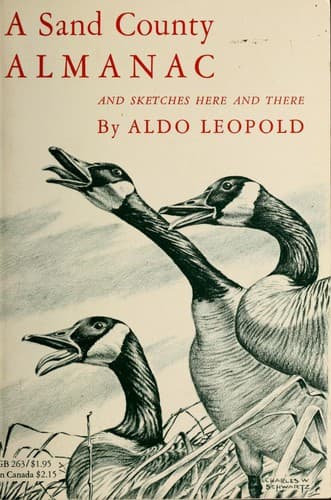
Book details and cover from Google Books.
Ready to read A Sand County Almanac?
Get your copy on Amazon, or listen to it on Audible. We earn a commission if you buy through these links.