
We earn a commission if you buy through these links. Learn more
A Memory Called Empire
Guide by the Books of the Day editors · Updated · How we write our guides
A space opera that treats court politics, language, and bureaucracy as seriously as spaceships, following an outsider ambassador surviving inside an empire bent on absorbing her.
What Creators Say About A Memory Called Empire
2 creators reviewed A Memory Called Empire on YouTube between 2019 and 2021, with 17.4K views between them. Their opinions are their own; we picked these reviews, we didn't write them.
What It's About
A Memory Called Empire follows Mahit Dzmare, a diplomat from Lsel Station, a semi-independent outpost whose people rely heavily on neural technology. Lsel sits uneasily beside Teixcalaan, a vast empire that has spent generations swallowing neighboring worlds. Mahit arrives in the imperial capital as the new ambassador after her predecessor died under unexplained circumstances. She carries his memories in a neural implant, which helps her navigate a foreign court but also unsettles her sense of who she is and whose judgment she is acting on.
Martine builds the novel from inside Teixcalaanli culture. Court life runs on poetry, elaborate protocol, and a bureaucracy that expresses power through allusion and ritual. Much of the pleasure comes from watching Mahit learn to read a society where nearly every gesture carries a second meaning, and from the sense that language itself is a contested territory. The prose is dense and deliberate, full of invented vocabulary and cultural detail that the reader absorbs rather than has explained.
Reading it feels like working a puzzle while being charmed by it. The pace is methodical rather than explosive, with long stretches of conversation, reading, and social maneuvering punctuated by sharp, sometimes violent turns. Readers who enjoy immersive worldbuilding and protagonists who think their way through problems on the page will find it rewarding. Readers expecting a fast action plot may find the opening slow going.
Read this if you…
- enjoy political intrigue set inside a richly invented imperial culture
- want science fiction that prizes ideas about language, identity, and power
- prefer a literary, sensory voice to fast, cinematic set pieces
Skip it if you…
- need brisk action from the first chapter
- find dense invented vocabulary and court protocol tiring rather than engrossing
Key Ideas
- 1
Identity shaped by inherited memory
Mahit's implant holds her predecessor's recollections, so she must constantly ask which thoughts are her own and which belong to someone else. The book uses this to explore inheritance, loyalty, and the difficulty of acting as yourself when your mind is partly borrowed.
- 2
Empire as culture, not only conquest
Teixcalaan absorbs other peoples less by force than by making them want its literature, aesthetics, and citizenship. Martine shows assimilation as a form of soft power, and asks what it costs a people to be welcomed into a civilization that is also swallowing them.
- 3
Language and poetry as instruments of power
In this court, verse, allusion, and formal speech are operational tools rather than decoration. Mahit's survival depends on decoding what is said, what is implied, and what is meant to be overheard, which makes reading itself a kind of espionage.
- 4
The outsider's view of an imperial center
Seen through Mahit, the empire is both dazzling and threatening. The book keeps the reader aware of Lsel's precarious position, so admiration for Teixcalaanli culture sits alongside an unease about what that culture is for.
- 5
Bureaucracy as texture and drama
Administrative rank, paperwork, and ceremony are not background details here. They shape how people move, who gets trusted, and how danger arrives, giving the political plot a grounded, tactile feel.
Limitations
The most common complaint is the density of the prose and the sheer number of unfamiliar terms, which can make the early chapters feel like a slog until the world clicks into place. Some readers find the central mystery less gripping than the worldbuilding, and Mahit's emotional life can feel reserved and held at a distance. The book is also the first in a series, so it leaves several threads open and works best as a launch rather than a self-contained story.
Questions Readers Ask
- Is A Memory Called Empire a standalone novel?
- No. It is the first book in the Teixcalaan series, and its sequel, A Desolation Called Peace, picks up directly from it. The first book sets up the world, the characters, and the central tensions, so reading both in order is strongly recommended for a satisfying experience.
- Do I need background in Byzantine history to enjoy it?
- No. Teixcalaan echoes the texture of Byzantine court life and other imperial bureaucracies, and many readers notice those resonances, but the novel explains its own customs and vocabulary through Mahit's experience. Familiarity helps with the appreciation of the court culture but is not required.
- How does it compare to Ann Leckie's Ancillary Justice?
- Both are space operas about empires and identity, but Martine's book is more focused on diplomacy, language, and court politics than on a single AI's fractured perspective. Readers who loved Leckie's attention to culture and political texture will likely find much to enjoy here.
- Published
- 2019
- ISBN
- 9781250186447
- Difficulty
- intermediate
- Category
- Science Fiction
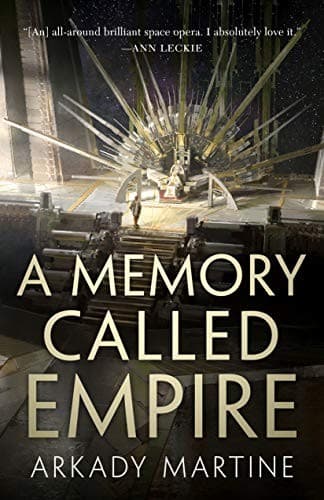
Book details and cover from Google Books.
Ready to read A Memory Called Empire?
Get your copy on Amazon, or listen to it on Audible. We earn a commission if you buy through these links.