
We earn a commission if you buy through these links. Learn more
A Lesson Before Dying
Guide by the Books of the Day editors · Updated · How we write our guides
A quietly devastating Louisiana novel about a wrongly condemned young man and the reluctant teacher asked to help him face death with dignity, told with restraint and deep humanity.
What Creators Say About A Lesson Before Dying
2 creators reviewed A Lesson Before Dying on YouTube between 2012 and 2023, with 8.6K views between them. Their opinions are their own; we picked these reviews, we didn't write them.
What It's About
A Lesson Before Dying is set in a small, segregated Louisiana parish in 1948, where a young Black man named Jefferson is sentenced to death for a killing committed during a store robbery he had no part in. The story is narrated by Grant Wiggins, a schoolteacher at the plantation school who has little interest in the case and mostly wants to leave town. When Jefferson's godmother asks for help, Grant is pressed into a task he never wanted: trying to help a condemned man face his death as a man, not as the court has treated him.
Ernest J. Gaines writes in a plain, conversational first person that moves between Grant's classroom, his home, and the visits to the jail. The prose is spare and the pacing deliberate, so much of the power comes from small exchanges, awkward silences, and the regional speech of the community rather than from action. The book takes its time, and that slowness lets the reader feel how little has changed for these people and how much hope costs them.
Reading it is a quiet, heavy experience. It is short enough to finish in a few sittings, but it asks you to sit with hard questions about witness, guilt, and what a community owes the people it condemns. Expect an emotional book that trusts you to do much of the thinking yourself.
Read this if you…
- want a short, emotionally serious novel about race and the American South
- are interested in how ordinary people sustain dignity under cruel institutions
- enjoy character-driven fiction where the big moments arrive through small, careful details
Skip it if you…
- need a fast plot with twists and steady suspense
- find slow, dialogue-heavy stories with little action hard to stay with
Key Ideas
- 1
Dignity as something people must claim
Gaines returns again and again to the idea that dignity is not handed out by a court or a society but has to be held onto by the individual and by the people who love him. Jefferson has been denied nearly everything, yet the question the book keeps asking is what he can still choose for himself, and how others can help him make that choice.
- 2
What teaching is actually for
Grant begins by seeing his job as getting through the school year and getting out of Bayonne. The assignment forces him to reckon with what education is meant to give people, and with his own complicity in a system that starved the community of schools, pay, and respect. His arc is less about heroism than about slowly accepting responsibility.
- 3
The community as witness
Miss Emma, the church, and the families around Jefferson treat his fate as something they must share. The book shows how a crowd of ordinary people can give a condemned man meaning simply by refusing to look away, and how that solidarity carries both comfort and a painful sense of obligation.
- 4
A justice system that decides in advance
The trial and the sentence reveal a legal machinery built to protect the powerful and to treat Black defendants as expendable. Gaines does not dwell on courtroom procedure; instead he shows its effects on the people left behind, making the injustice feel personal, daily, and unresolved rather than abstract.
Limitations
Some readers find the novel's emotional register overly sentimental, especially in its portrayal of Jefferson as a figure of quiet, saintly endurance. Others note that the story is filtered through Grant, a narrator who is himself uncertain and sometimes self-absorbed, so the reader sees Jefferson mostly from outside. White characters are drawn with less depth than Black ones, and the plot moves slowly by design, which can feel repetitive to readers expecting momentum. The setting is specific to a particular time and place, and its portrayal of Jim Crow Louisiana is unflinching but limited in scope.
Questions Readers Ask
- Is A Lesson Before Dying still relevant today?
- Yes. Its concerns about wrongful convictions, capital punishment, and the unequal treatment of Black defendants remain urgent, and readers continue to find its portrait of dignity under pressure moving. The setting is 1948, so the book reads as a historical novel, but the questions it raises about who the justice system protects are still widely discussed.
- How does it compare to To Kill a Mockingbird?
- Both novels center on a wrongly accused Black man in the segregated South and a white narrator who learns hard lessons about race. Gaines's book is more intimate and less focused on a courtroom drama, and its narrator is a Black teacher rather than a child. Readers who loved Harper Lee's novel often find this one quieter, more painful, and more concerned with the community than with the trial.
- Published
- 1993
- ISBN
- 9780679414773
- Difficulty
- beginner
- Category
- Fiction
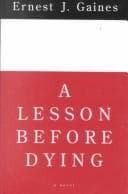
Book details and cover from Google Books.
Ready to read A Lesson Before Dying?
Get your copy on Amazon, or listen to it on Audible. We earn a commission if you buy through these links.