
We earn a commission if you buy through these links. Learn more
A history of the world in 100 objects
by Neil MacGregor, Neil MacGregor
Guide by the Books of the Day editors · Updated · How we write our guides
A museum tour in book form: MacGregor uses 100 objects, from a two-million-year-old stone tool to modern times, to show how human history connects across cultures and continents.
What Creators Say About A history of the world in 100 objects
2 creators reviewed A history of the world in 100 objects on YouTube between 2011 and 2019, with 6.2K views between them. Their opinions are their own; we picked these reviews, we didn't write them.
What It's About
Neil MacGregor, then director of the British Museum, built this book from a BBC Radio 4 series in which he talked about one object at a time, each segment lasting roughly fifteen minutes. The chapters run broadly in chronological order, beginning with a stone tool made more than two million years ago and moving toward the present. Each entry is a short essay centred on one object, often drawn from museum collections around the world, and each is written to stand on its own.
The method is the object as a starting point. MacGregor uses each piece to open onto wider questions about trade, belief, power, craft and everyday life, then moves on before the reader has time to settle. The tone is conversational and unhurried, closer to a guided walk through galleries than to a textbook. You do not need to read it in order, and it rewards dipping in and out.
The experience is one of breadth rather than depth. Each object gets a few pages, so you come away with a sense of how much the world has shared, and a new habit of looking closely at ordinary things. It works as an introduction, a gift, or a book to read in short sittings.
Read this if you…
- want a broad, friendly overview of world history without memorising dates and dynasties
- enjoy museums and want a book that teaches you how to look at things
- are looking for a gift for someone curious who does not read dense academic history
Skip it if you…
- want a continuous, detailed narrative of any one period, region or war
- expect a rigorous argument with extensive sourcing and scholarly debate
Key Ideas
- 1
Objects as evidence of human lives
MacGregor treats material things as records of how people lived, worked, worshipped and governed. A tool, a coin or a sculpture can tell you about a society's skills and assumptions in a way that written sources often cannot. The book's central argument is that careful looking can recover history for periods and peoples who left few texts behind.
- 2
Connection through trade and exchange
Many of the objects were made in one place and found, copied or valued far away. The book repeatedly shows that cultures were linked long before modern globalisation, through trade routes, borrowed designs and shared materials. This reframes history as a web of contact rather than a set of separate civilisations developing in isolation.
- 3
How objects carry meaning and power
Many pieces were made to express authority, faith or identity, and their meanings shifted as they passed between owners and eras. MacGregor pays attention to how a single object could mean different things to its makers, users and later collectors. This makes the book useful for thinking about why people have always invested objects with significance.
- 4
Ordinary things alongside treasures
The selection is not limited to gold, sculpture or famous relics. Everyday items sit beside prestige pieces, and the book suggests that domestic and practical objects can reveal as much about a society as its grandest works. The effect is to widen what counts as history and to make the past feel inhabited by people rather than rulers alone.
Limitations
Because each object gets only a few pages, many regions, periods and cultures are touched on briefly, and the coverage inevitably reflects choices about what to include. Critics have pointed out that the selection draws heavily on British Museum holdings, which raises questions about how collections were acquired, including objects taken during colonial periods. The book is also more evocative than analytical, so readers wanting a detailed explanation of causes or historiographical debate will need to look further.
Questions Readers Ask
- Is A History of the World in 100 Objects suitable for beginners?
- Yes. The writing is clear and conversational, each chapter is short and self-contained, and no prior knowledge of archaeology or history is assumed. It is one of the more accessible books on world history, though its brevity means you will want to follow up on any object or culture that catches your interest.
- How does it compare with a traditional world history book?
- A traditional world history follows events, rulers and causes in sequence, with much more depth on each period. MacGregor instead builds the story from physical evidence, so you get a vivid sense of material life but less on political narrative. Readers who want both might pair it with a conventional survey.
- Is it still worth reading?
- Yes, because its method and most of its examples remain sound and interesting. The book was published in 2010, so some interpretations may have been revised since, but it is valued mainly as an invitation to explore objects and history rather than as a final scholarly account.
- Published
- 2010
- ISBN
- 9780141966830
- Difficulty
- beginner
- Category
- History
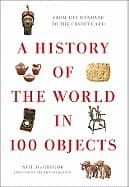
Book details and cover from Google Books.
Ready to read A history of the world in 100 objects?
Get your copy on Amazon, or listen to it on Audible. We earn a commission if you buy through these links.