
We earn a commission if you buy through these links. Learn more
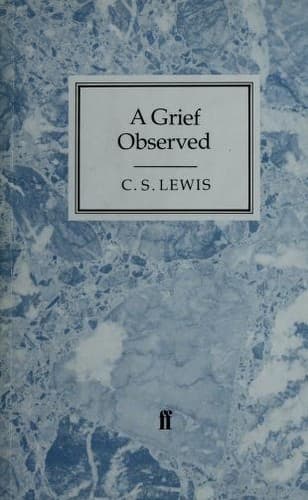
A Grief Observed
by C. S. Lewis
Guide by the Books of the Day editors · Updated · How we write our guides
A short, unsparing notebook of grief in which C. S. Lewis turns his faith and doubt on himself after losing his wife, and finds no easy comfort.
What Creators Say About A Grief Observed
2 creators reviewed A Grief Observed on YouTube between 2019 and 2023, with 14.2K views between them. Their opinions are their own; we picked these reviews, we didn't write them.
What It's About
A Grief Observed is Lewis's written response to the death of his wife, Joy Davidman, who died in 1960 after her cancer returned. Lewis published it in 1961 under the pseudonym N. W. Clerk. It is nonfiction, a personal journal rather than a novel, though it reads with a novelist's attention to mood and detail. It began as private notebook entries written in the months after her death, and it still reads that way: loosely arranged fragments, shifts in tone, arguments with himself, and sentences that stop and restart.
The approach is observational. Lewis does not build toward a tidy argument or a reassuring conclusion. He watches his own grief the way the title suggests, with a detached, almost clinical eye, and that coolness is part of what makes the book unsettling. The prose is plain and sometimes sharp, often dryly funny, and he is willing to say things that sound unfaithful: that God seems absent, that prayer feels like talking into a void, that he cannot tell whether his faith is holding him up or merely looking away.
Reading it is brief but intense. It works best read slowly, in a sitting or two, and it offers none of the structure of a self-help book. It is a companion for people in the middle of loss, not a manual for getting over it, and many readers return to it for its honesty rather than its answers.
Read this if you…
- want an honest account of grief from someone who refuses easy consolation
- are grieving or have lost a spouse and would rather have company than advice
- are interested in how religious belief holds up under real suffering and doubt
Skip it if you…
- want practical guidance, stages of grief or step-by-step coping strategies
- are looking for a systematic defense of Christianity or a clear argument for faith
Key Ideas
- 1
Grief as an experience of the whole self
Lewis notices how grief is physical as well as emotional. It disrupts sleep, appetite, memory and the sense of time, and it changes shape without warning. He treats these bodily details as serious evidence about what loss actually does to a person, rather than as background to the real feelings.
- 2
Faith tested rather than settled
The book's central tension is between belief and the silence that follows a death. Lewis does not dismiss his doubts or dress them up. He asks whether his earlier confidence was real, whether prayer does anything, and what it means to love God when God seems unresponsive. The questions stay open.
- 3
Memory and the changing image of the dead
Lewis watches how his memory of Joy shifts, sometimes softening her, sometimes idealizing her, and sometimes slipping away in ways that frighten him. He is alert to the danger of building a comforting version of the person and losing the actual one, and this concern runs through the whole book.
- 4
Observation as a discipline of honesty
The act of writing down his grief day by day is itself a theme. Lewis refuses both self-pity and pious display, holding himself to a standard of accuracy. For readers, this stance shows how writing can be a way of staying truthful when a situation makes self-deception very tempting.
Limitations
The book is one man's private reflection, written from within a specific Christian tradition, and readers outside that framework may find its theology dense or frustrating. Its fragmentary form gives little narrative context about Joy herself, so anyone hoping for her story or a full portrait of the marriage will find it sparse. Some readers find the tone self-absorbed or emotionally cool, especially given the observational frame. These are fair objections, and the book is best approached knowing its aims are introspective rather than biographical.
Questions Readers Ask
- Is A Grief Observed still relevant for readers who are not Christian?
- Yes. The religious questions are specific to Lewis, but the physical texture of grief, the strange moods, and the fear of forgetting the dead are universal. Readers who doubt, or who have felt that prayer goes unanswered, often find his honesty about those feelings valuable even if they do not share his conclusions.
- How does it compare to Joan Didion's The Year of Magical Thinking?
- Didion's book is longer, more structured and more reported, built around the first year after her husband's death. Lewis's is shorter, more lyrical and more openly theological. Readers who want a sustained, analytical account of bereavement may prefer Didion, while those drawn to spiritual struggle tend to find Lewis more direct.
- Published
- 1961
- ISBN
- 9780061949289
- Difficulty
- intermediate
- Category
- Fiction
Book details and cover from Google Books.
Ready to read A Grief Observed?
Get your copy on Amazon, or listen to it on Audible. We earn a commission if you buy through these links.