
We earn a commission if you buy through these links. Learn more
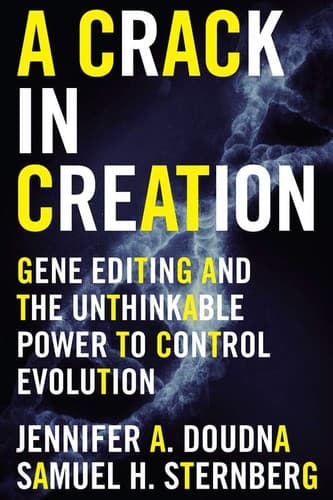
A Crack in Creation
by Jennifer A. Doudna, Samuel H. Sternberg
Guide by the Books of the Day editors · Updated · How we write our guides
An insider's account of how CRISPR went from an obscure bacterial immune system to a gene-editing tool, told by one of the scientists who made it.
What Creators Say About A Crack in Creation
2 creators reviewed A Crack in Creation on YouTube between 2024 and 2026, with 104 views between them. Their opinions are their own; we picked these reviews, we didn't write them.
What It's About
The book follows CRISPR from a puzzling pattern of repeated DNA in bacteria to a method that lets scientists cut and rewrite genetic code in nearly any organism. Jennifer Doudna is a biochemist whose Berkeley laboratory helped turn that discovery into a practical tool, and she wrote the book with Samuel Sternberg, who worked in her lab. The result is part science primer and part insider history. Much of the story concerns people and decisions: the slow work of figuring out what the bacterial enzyme actually does, and the moment the team saw it could be aimed at a chosen spot in a genome.
The explanations are patient and build step by step, so a reader without a biology background can follow how a guide molecule directs an enzyme to a particular sequence. The tone is measured and reflective rather than dramatic. The authors are describing events they lived through and have a stake in, and they say so openly, which gives the narrative a candid, personal feel. Expect a steady pace and clear reasoning rather than thriller-style tension.
Reading it is closer to following an argument than a story. The later chapters turn from the laboratory to the questions that editing raises, especially whether and how the technique should be used on human embryos, and to the bitter dispute over who holds the patents. The book treats these as open problems facing a young field, not settled matters. It is a record of scientists deciding, in real time, what to do with a powerful new capability.
Read this if you…
- want an inside view of how a major scientific discovery actually unfolded
- are curious about gene editing and its ethics but want a clear, non-technical explanation
- want to understand how scientific credit and patents shape research
Skip it if you…
- want a current overview of gene editing's clinical applications or recent breakthroughs
- prefer a neutral history written by people with no stake in the story
Key Ideas
- 1
CRISPR started as a bacterial immune system
Bacteria keep short snippets of DNA from past viral infections and use them to recognize and disable returning invaders. The book explains how researchers recognized this defense as a natural molecular machine, with an enzyme that cuts DNA guided by RNA, and why that insight mattered well beyond microbiology.
- 2
A programmable cut in any genome
The key step was seeing that the guide molecule could be designed to match almost any sequence, so the enzyme could be pointed at a chosen location. The authors describe how this turned a specialized bacterial process into something any lab could use, and why that flexibility is both the technique's power and the source of its risks.
- 3
Science, competition, and credit
The account of the rush to publish and to claim priority is candid about how fast the field moved and how collaborations and rivalries shaped who got recognized. It shows how scientific credit, funding, and patent law interact, and gives a useful picture of how discoveries get made in competitive labs.
- 4
The ethics of editing human embryos
The book argues that editing the human germline raises questions beyond the lab, including safety, consent for future generations, and the difference between treating disease and enhancing traits. The authors take these risks seriously and push for careful public discussion rather than quiet progress.
Limitations
The book is written by two people close to the events, so its account of priority and credit reflects their vantage point, and rival researchers' views get less space than they might. Published in 2017, it predates later developments in human editing and the clinical trials that followed, so it cannot tell you where the field stands today. Readers seeking deep technical detail or broad coverage of agriculture and medicine will find it lighter than they might want.
Questions Readers Ask
- Do I need a science background to read A Crack in Creation?
- No. The authors explain the core biology step by step and avoid jargon where they can, so a motivated general reader can follow the main ideas. Some passages on molecular mechanisms take concentration, but the narrative and the ethical discussion do not depend on them.
- Is it still relevant after newer developments?
- The scientific foundation remains accurate, and the basic story of how CRISPR-Cas9 was discovered and adapted still matters. But the book came out before the major ethical controversies and clinical developments that followed, so pair it with a more recent source for the current state of the field.
- How does it compare to Walter Isaacson's The Code Breaker?
- Isaacson's book is a broader journalistic account that covers the wider field and many more voices. A Crack in Creation is narrower and more personal, written from inside one lab's perspective. Read Isaacson for context and rival viewpoints, and Doudna and Sternberg for firsthand detail on the science and the decisions.
- Published
- 2017
- ISBN
- 9781543660630
- Difficulty
- intermediate
- Category
- History
Book details and cover from Google Books.
Ready to read A Crack in Creation?
Get your copy on Amazon, or listen to it on Audible. We earn a commission if you buy through these links.