
We earn a commission if you buy through these links. Learn more
84, Charing Cross Road
by Helene Hanff
A funny, moving friendship told entirely through letters, in which a New York writer and a London bookshop staff become close over twenty years, all through a search for secondhand books.
What It's About
84, Charing Cross Road is a short book made almost entirely of letters. Helene Hanff, a writer in New York with little money, begins corresponding in the late 1940s with Marks & Co., a London bookseller whose address gives the book its title. She wants out-of-print English books that are hard to find in America, and the early letters are brisk business: titles requested, prices discussed, parcels sent and delayed. Over the years the exchanges widen into something warmer, as Hanff and the shop's staff trade jokes, news of their lives, and small kindnesses across an ocean.
The book's appeal lies in its voice. Hanff is blunt, funny, and quick to complain about bad service or a poor edition, and her letters carry the rhythm of someone who loves books more than almost anything. The London side is quieter but no less vivid, shaped by the hardships of postwar Britain, and the gaps between letters do much of the work. You learn about both correspondents from what they choose to mention and what they leave out.
Reading it feels like eavesdropping on a long, affectionate conversation. It takes an evening, not a week, and it rewards slow reading more than speed. Expect a book that is warm and wry rather than plotted, with its emotional force building from accumulation rather than any single dramatic moment.
Read this if you…
- love books about books, or enjoy seeing how readers talk about the titles they chase
- want a warm, funny read that you can finish in one sitting
- enjoy epistolary writing and like working out characters from what they leave unsaid
Skip it if you…
- need a plot with rising stakes, conflict, or a clear narrative arc
- are looking for a detailed history of the London book trade or of postwar Britain
Key Ideas
- 1
Books as a bridge between strangers
The whole relationship starts from a practical request for out-of-print titles. Hanff's reading tastes and the shop's knowledge of stock become the common ground that lets two people who never meet build real trust. The book shows how a shared love of a subject can carry a friendship that ordinary social life would never have produced.
- 2
Letters as a form of character
Because the book contains only correspondence, every personality comes through in tone, humor, and what gets mentioned. Hanff's directness and the London staff's restraint feel distinct on the page. Readers get a portrait of two people without any narrator telling them what to think of either.
- 3
Generosity across hardship and distance
Much of the warmth in the book is practical. Money is tight on both sides, and the letters record gifts and sacrifices made in the years after the Second World War. The book makes the point that kindness often looks like sending something useful, even when it costs more than the sender can easily afford.
- 4
The pleasure of a slow, episodic story
Time passes in jumps between letters, so the reader fills in years of life from fragments. This gives the book a melancholy undertow alongside its humor. It is a useful example of how a small, unassuming format can carry a great deal of feeling without raising its voice.
Limitations
The book is slight by design. Readers who want deeper context about the bookshop, the wider world of antiquarian dealing, or the period's politics will find only what the letters happen to mention. Some readers find the early letters transactional and repetitive, and the sentimental tone of the later exchanges can feel dated to those who prefer a cooler style. Because it is one side of a relationship, with only the writers' own perspectives, it cannot tell you everything about the people involved.
Questions Readers Ask
- Is 84, Charing Cross Road a novel or a true story?
- It is based on real correspondence between Helene Hanff and the staff of Marks & Co. in London, published as a book in 1970. It is usually shelved as nonfiction or memoir, and its letters are presented as the actual exchanges. Readers who want a conventional plot should know that the story unfolds through the correspondence itself rather than through invented scenes.
- Who is this book best suited for?
- It suits readers who enjoy witty, personal writing and anyone with a love of books or bookshops. It is also a good choice for people who like quiet, character-driven reading. Those who need fast pacing or a tightly structured argument may find it too gentle, though its brevity makes it an easy first book to try.
- Published
- 1970
- ISBN
- 9781844085248
- Difficulty
- beginner
- Category
- Biographies
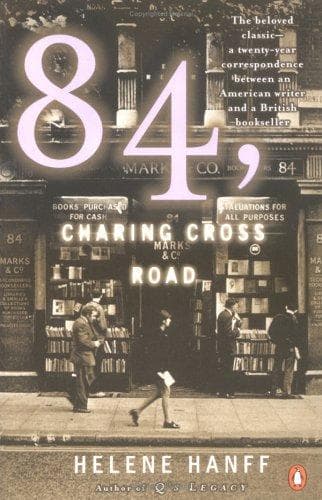
Book details and cover from Google Books.
Ready to read 84, Charing Cross Road?
Get your copy on Amazon, or listen to it on Audible. We earn a commission if you buy through these links.