
We earn a commission if you buy through these links. Learn more
4 3 2 1
by Paul Auster
Guide by the Books of the Day editors · Updated · How we write our guides
Paul Auster's four-times-told novel of one boy's branching life is an ambitious experiment in chance, identity, and American history, worth it for patient readers.
What Creators Say About 4 3 2 1
2 creators reviewed 4 3 2 1 on YouTube in 2017, with 44.3K views between them. Their opinions are their own; we picked these reviews, we didn't write them.
What It's About
4 3 2 1 is a long novel, running to roughly 850 pages, that follows Archie Ferguson, born in Newark, New Jersey, in March 1947. Auster does not tell one life. He tells four versions of Archie's youth and early manhood, each branching from the same starting point, so the same boy becomes four different young men shaped by different chances, family upheavals, and choices. Archie's family, the business his father runs, and the turbulent postwar American city pull at every version.
The method is deliberate and sometimes demanding. Auster writes in a plain, cumulative style, letting small variations build until the reader notices how much has shifted. Much of the pleasure lies in comparison: friendships, places, and turning points recur with new weight each time. Reading it feels less like following a single plot than like being handed a set of parallel lives and asked what separates them.
It is an immersive, slow read rather than a conventional page-turner. Expect long stretches of close domestic detail and a steady interest in writing, ambition, and the act of looking at the world. Readers who want fast momentum may find the repetition wearing, while those who enjoy layered, patient storytelling will find it rewarding.
Read this if you…
- want a sprawling, character-driven novel about how small accidents change a life
- enjoy comparing alternate versions of the same story and spotting what shifts
- like coming-of-age fiction set against the upheavals of postwar American history
Skip it if you…
- want a tight plot with a single through-line and a quick pace
- find long books with heavy repetition tiring rather than absorbing
Key Ideas
- 1
Chance as the engine of a life
The novel's central question is how much a person's life depends on accidents of timing, family, and place. By holding one boy constant while changing the events around him, Auster shows how a single shift can reroute ambition, love, and loss. The reader is invited to notice how fragile the line between one outcome and another can be.
- 2
One self, many possible selves
Each version of Archie is recognizably the same person, yet the differences in temperament and choice make him feel like several people. The book asks whether identity is a fixed core or something produced by circumstance. It does not settle the question neatly, which is part of its appeal for readers who like to think after they finish.
- 3
Coming of age against American history
Archie grows up through the postwar decades, and the public upheavals of those years, including urban change, the civil rights era, and campus protest, press on his private life. Auster uses these events to show how national history filters into family and friendship rather than standing apart from them. The historical texture gives the personal story weight.
- 4
The making of a writer
Archie's artistic ambitions, including his interest in writing and images, give the novel a reflective undercurrent. Questions about how a person turns experience into art, and what gets lost or gained in the process, run through several versions. Readers interested in fiction about writing will find much to chew on here.
Limitations
The length is the most common objection. At nearly nine hundred pages, the book asks a lot of patience, and some readers feel that the repeated scaffolding of each version slows the middle stretches. The four lives also do not always feel equally vivid; some readers find one or two versions more engaging than the others. Its view of the period is filtered through a single, largely privileged male perspective, which some critics find limiting. The book rewards commitment but does not hide its ambitions or its excess.
Questions Readers Ask
- Do I need to read Paul Auster's earlier books first?
- No. 4 3 2 1 works as a standalone novel, and you do not need familiarity with Auster's earlier fiction to follow it. Readers who already know his work will recognize his interest in chance, identity, and the writer's life, which adds a layer of pleasure, but it is not a prerequisite.
- How does it compare to Kate Atkinson's Life After Life?
- Both books replay a life through variations, so readers who enjoyed one often try the other. Atkinson's novel is generally more compact and tightly structured around one woman's repeated lives. Auster's is longer, more discursive, and more interested in the texture of ambition, writing, and postwar American history.
- Published
- 2013
- ISBN
- 9781250618801
- Difficulty
- intermediate
- Category
- Fiction
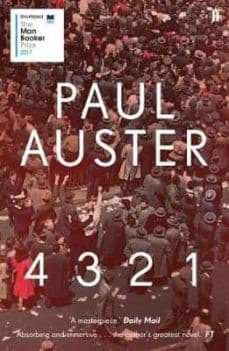
Book details and cover from Google Books.
Ready to read 4 3 2 1?
Get your copy on Amazon, or listen to it on Audible. We earn a commission if you buy through these links.