
We earn a commission if you buy through these links. Learn more
1776
Guide by the Books of the Day editors · Updated · How we write our guides
A vivid, human-scale account of the Revolution's bleakest year, when Washington's army nearly came apart and a few daring winter attacks changed the war's direction.
What Creators Say About 1776
2 creators reviewed 1776 on YouTube between 2020 and 2024, with 4.9K views between them. Their opinions are their own; we picked these reviews, we didn't write them.
What It's About
1776 is a narrative history of the American Revolution's most precarious year. It follows George Washington's Continental Army from the British evacuation of Boston in early 1776 through the New York campaign, the long retreat across New Jersey, and the surprise attacks at Trenton and Princeton that closed the year. McCullough builds the account largely from letters, diaries, and military records, so the people in it come across as specific individuals rather than names on a map.
The approach is chronological and scene-driven. The narrative moves between the American camps and the British command in New York, where Howe and his officers held overwhelming force and often seemed unsure how to use it. It also stays close to ordinary soldiers and militiamen dealing with cold, shortages, desertion, and fear. Although the outcome is known, the pacing is closer to a novel's, because the story keeps showing how near the cause came to collapse.
Reading it feels like following a campaign from the inside. McCullough's admiration for his subjects is obvious, and the book is more interested in logistics, weather, and nerve than in battle diagrams. It works well as a first long book on the period. It is less a political history of independence or the Declaration's drafting, and readers wanting that will need more.
Read this if you…
- want a clear, gripping introduction to the Revolutionary War's military story
- enjoy history told through letters, diaries, and vivid scenes rather than analysis
- are curious about the human side of the army, not just its generals
Skip it if you…
- want a detailed political or intellectual history of independence and the Declaration
- are looking for a critical account that questions the heroic framing of Washington and the founders
Key Ideas
- 1
Survival mattered more than victory
For much of the year the army was more likely to dissolve than to win. McCullough argues the Revolution was kept alive by persistence, retreat, and a willingness to keep fighting after repeated failures. The book treats endurance as a strategy in its own right, and it makes the case that a losing army that keeps its shape can still change a war.
- 2
British superiority and missed opportunities
The British had the larger fleet, the better-trained troops, and several chances to end the rebellion quickly in New York. The book examines why they hesitated, and how their caution gave Washington time to regroup. It is a useful corrective to the idea that American success was inevitable.
- 3
The cost borne by ordinary soldiers
Much of the narrative is about enlisted men and militia who marched without proper clothing, pay, or food and whose enlistments were ending at the worst moments. McCullough uses their letters and diaries to show what the war felt like at ground level, which gives the military events their emotional weight.
- 4
Washington's leadership under pressure
Washington makes serious errors in New York and is shown learning from them. The book presents him as a commander who was often wrong, improvised under stress, and gradually improved. That portrait is more complicated than the statue version, though McCullough's sympathy for him is clear throughout.
- 5
Surprise attacks as a turning point
The crossing of the Delaware and the attacks at Trenton and Princeton were small in scale but large in effect. The book shows how these actions restored morale and changed the strategic picture. It is an effective account of how a few bold moves in bad weather can reshape a war's momentum.
Limitations
The book is often criticized for an admiring, sometimes heroic tone toward Washington and the Continental Army, which can smooth over his mistakes and the army's internal divisions. It concentrates on military campaigns and leaves much less room for politics, Loyalist perspectives, Native nations, and enslaved people, whose experiences of the war differed sharply. Some historians also see it as popular narrative built on a relatively narrow set of sources, though the scholarship it draws on is widely respected.
Questions Readers Ask
- Is 1776 a good first book about the American Revolution?
- Yes, for most general readers it is an excellent starting point. It is narrative, not academic, and it focuses on one dramatic year. The military movements can get dense in places, but McCullough keeps the human stakes clear. Readers who finish it often go on to more analytical works.
- How does 1776 compare with Gordon Wood's writing on the Revolution?
- McCullough tells a story about soldiers and commanders during one year, while Gordon Wood's work focuses on ideas, politics, and social change across the Revolutionary era. Readers who want to understand the war's human experience will prefer McCullough. Those who want to understand what the Revolution meant for society will need Wood.
- Is 1776 still worth reading given newer scholarship?
- Yes, as a readable narrative of the military campaign, it still holds up well. Newer work has expanded attention to women, enslaved people, Loyalists, and Native nations, so pair it with those perspectives. Treat it as a strong account of one part of the war rather than the final word.
- Published
- 2005
- ISBN
- 9781613836309
- Difficulty
- beginner
- Category
- History
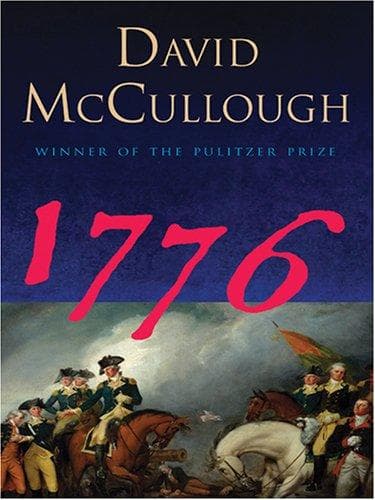
Book details and cover from Google Books.
Ready to read 1776?
Get your copy on Amazon, or listen to it on Audible. We earn a commission if you buy through these links.