
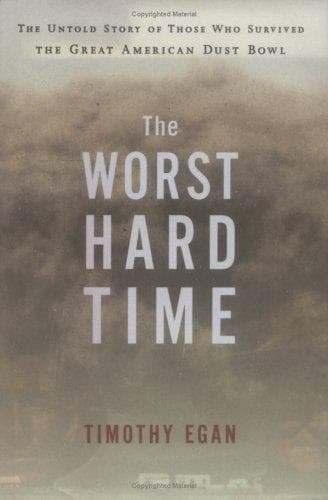
The worst hard time
Timothy Egan
This nonfiction account of the families who stayed in the Dust Bowl shows the black blizzards and ruined farms that drove the Joads west, told through real survivors' stories.
Reader-supported: when you buy through links on our site, we may earn an affiliate commission. Learn more
We earn a commission if you buy through these links. Learn more
Find Similar BooksA furious, tender road novel about a displaced farm family that still stands as one of the most vivid accounts of American hardship in the 1930s.
The Grapes of Wrath follows the Joads, a tenant farming family from Oklahoma who lose their land to drought, debt, and the machinery of banks and large landholders, and set out for California in search of work. Most of the book travels with them on the highway and through the labor camps they find along the way, where wages are cut, families compete against each other for jobs, and hope is sold back to them at a markup. Steinbeck interleaves the family story with shorter interchapters that step back to show the wider migration as a mass event, a shift in perspective many readers find as memorable as the family itself.
The prose is plain, rhythmic, and often biblical in cadence, with long sentences that build like weather and dialogue that carries regional speech without much apparatus. Steinbeck moves between close attention to individual suffering and broad, almost sermonlike passages about property, labor, and what people owe one another. The experience is immersive and emotionally heavy. It shifts between anger, grief, and a stubborn, sometimes startling tenderness, and it does not hurry to comfort the reader. Expect long stretches of hardship before the book lets anyone catch a breath.
Readers come away with a sharp sense of how the Dust Bowl and the Depression felt from the ground, not just as statistics. The novel is less a neat plot than a series of pressures on one family, and its moral argument is pressed openly. That openness is part of its power and part of what makes it hard to read with detachment.
The novel shows how land consolidation, bank foreclosures, and mechanized farming push tenants off their homes without any single villain being responsible. Steinbeck presents the process as a system that treats people as costs, and much of the book's anger comes from that gap between the human stakes and the cold logic that drives them.
As the family's circle widens to include strangers, the book argues that solidarity is both practical and moral. The tension between looking out for yourself and sharing what little you have runs through nearly every scene, and the novel keeps testing how far that shared obligation can stretch under pressure.
Ma Joad is the steady center of the story, and the book locates strength less in heroic gestures than in patient, practical work: feeding people, keeping a family together, and refusing to give up. Steinbeck treats this quiet resilience as the real measure of character in hard times.
The novel moves toward the idea that wrongs are ended by people acting together rather than by individual rescue. Its preacher-like characters voice this idea in broad terms, and while some readers find the argument heavy-handed, it is central to what the book wants readers to take away.
Critics have long argued that the novel's sympathy for the migrants is real but sometimes sentimental, and that Steinbeck, who was not himself a migrant farmer, leans on symbolism and sermon-like chapters at moments when more specificity would help. Its portrayal of women, nonwhite workers, and the wider social world is narrow by modern standards, and the dialect can be tiring over hundreds of pages. The book also focuses on one migrant experience in California rather than the whole Depression, and its politics were controversial enough that it was publicly attacked and banned in some places.
Reviews from readers on YouTube. Their opinions are their own.
Book details and cover from Google Books.
Ready to read The Grapes of Wrath?
Get your copy on Amazon, or listen to it on Audible. We earn a commission if you buy through these links.
Timothy Egan
This nonfiction account of the families who stayed in the Dust Bowl shows the black blizzards and ruined farms that drove the Joads west, told through real survivors' stories.
Kristin Hannah
A Texas mother flees the Dust Bowl for California and meets the same hostility, hunger and labour exploitation the Joads face, in a more emotional, character-driven contemporary novel.
James Agee, Walker Evans
Agee's prose and Walker Evans's photographs document Alabama tenant farmers in the 1930s, offering the real faces behind Steinbeck's fictional families and a similar outraged compassion.
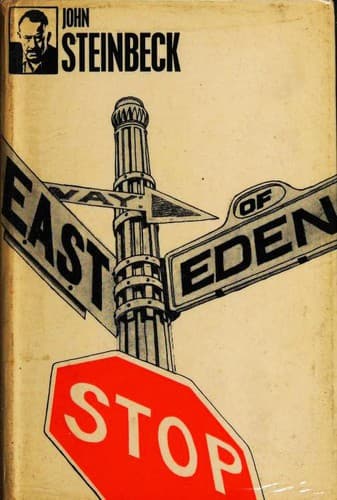
John Steinbeck
Steinbeck's other great epic spans generations in California's Salinas Valley, with the same grand moral vision, biblical echoes and interwoven narrator commentary that gave the Joads' story its scale.