
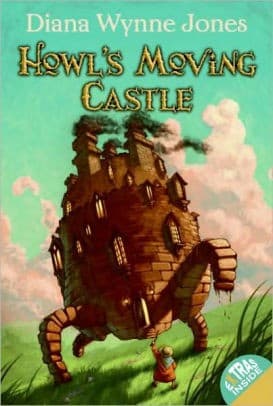
Howl's Moving Castle
Diana Wynne Jones
A cursed girl, a wizard and a moving castle give the same playful, sly fairy-tale spirit. Jones mixes whimsy with sharp wit, much as Barnhill does with her witch and her Swamp Monster.
Reader-supported: when you buy through links on our site, we may earn an affiliate commission. Learn more
We earn a commission if you buy through these links. Learn more
Find Similar BooksA lyrical, warm-hearted fairy tale about love, grief, and the lies communities tell themselves, layered enough to reward adults reading alongside children.
In a gloomy town called the Protectorate, families give up a baby every year to appease a witch they fear. The twist the reader learns right away is that the witch, Xan, is gentle. She carries each abandoned infant to a loving home on the far side of the forest. When she accidentally feeds one baby moonlight, the child becomes saturated with magic, and Xan raises her as her own. The story then follows several threads: Luna growing up in a household that includes a poetry-loving swamp monster and a very small, very vain dragon; a young man in the Protectorate questioning the town's rituals; and the powers that profit from keeping everyone afraid.
Barnhill writes in an old-fashioned, storyteller's voice, shifting among many perspectives and slipping in short, mysterious passages narrated by someone telling the tale to a child. The prose is rich and sometimes deliberately slow, closer to a fable than a fast-paced adventure.
Reading it feels like sitting with a long bedtime story that keeps opening into bigger questions. Beneath the whimsy sits real sadness, including a mother's loss and a town drowning in sorrow, but the book's emotional center is tenderness and the stubborn persistence of hope. It works well as a read-aloud and tends to land differently for children and the adults sharing it with them.
The Protectorate's misery is not an accident. Those in charge keep people frightened and grieving because it serves them. Barnhill shows how a story repeated often enough becomes unquestioned truth, and how asking simple questions can break its hold. Younger readers get an accessible picture of propaganda, and older readers will notice the sharp political undertone.
Grief runs through nearly every character, from a mother who cannot stop mourning to an old witch whose own memories are fragmentary. The novel treats sorrow as something real and weighty that can be exploited, carried, or eventually transformed. It never pretends sadness disappears easily, which gives the hopeful moments more weight.
Xan's choice to raise Luna, Glerk's patient devotion, and the fierce love of family across distance drive the plot more than any spell. The book argues that ordinary care and loyalty shape a person more than raw power does, and that protecting someone sometimes means trusting them with the truth.
Rather than following one hero, the narrative rotates among a large cast and interrupts itself with short framing passages. This gives the book a timeless, folkloric quality and lets readers see the same events from opposite sides of the forest, though it also demands some patience before the threads come together.
The most common complaint is pacing: the opening is slow, and the frequent jumps between characters can make the first third feel scattered, especially for younger or reluctant readers. Some adults also feel the many threads resolve too quickly near the end after such a long build. The lyrical style is a matter of taste, and readers expecting a conventional quest may find it meandering. Some heavy themes, including a grieving mother and child sacrifice as a premise, may need a grown-up nearby for sensitive readers.
Reviews from readers on YouTube. Their opinions are their own.
Book details and cover from Google Books.
Ready to read The Girl Who Drank the Moon (Winner of the 2017 Newbery Medal)?
Get your copy on Amazon, or listen to it on Audible. We earn a commission if you buy through these links.
Diana Wynne Jones
A cursed girl, a wizard and a moving castle give the same playful, sly fairy-tale spirit. Jones mixes whimsy with sharp wit, much as Barnhill does with her witch and her Swamp Monster.
Kate DiCamillo, Timothy B. Ering
Its direct, chatty narrator addresses the reader and turns a small hero into a story about kindness and darkness. Fans of Xan's gentle, unusual world will recognise the same fable-like warmth.
Neil Gaiman
A child is raised by the residents of a graveyard, a found family that feels as odd and loving as Xan's household. Its mix of eerie atmosphere and tenderness suits readers drawn to Barnhill's quiet magic.
Sara Pennypacker
A boy and a fox share a deep bond and are forced apart, a journey built on loyalty and longing. Like Luna's story, it pairs an animal companion with emotional stakes that feel large for a young reader.